Failures of SUNVIC motorised valves
including those with EcoSmart actuators (previously called SZM 1801 and SDM 1901) Unishare
valves also SZMV2305 (and spring return types 2301 and 2701 and variants). Also
DuoVal DM5601 and DM5651 Updated
March 2025.
REPAIR SERVICE for
Sunvic actuators.
Please note: this is an
occasional hobby, not a business! All sales and repairs are on a private basis.
I have repaired hundreds of Sunvic and other makes of actuators - primarily as one of my
hobbies and so that I could examine and photograph interesting failures. You can see many
examples on this website. I still have a few spare parts - you can always ask. I
offer a mail-order repair service for some types of actuators. This can include
replacing faulty micro-switches, which is a less common cause of failure, at least in Mo Mo
actuators.
For decades
I have undertaken all my own car repairs, building projects and plumbing and
electrical work, and for quite a few friends! One 'on site'
investigation of a very unusual plumbing problem is here.
I'm basically a physicist, author and building scientist - and I'm very
practical.
I have developed a modified design for 2-port Sunvic
Ecosmart/1801/1802/1808/1809 series actuators. These are suitable for use on a system
where the valve spindle is leaking a little - (this would be your own actuator modified to
my own design, provided the motor is OK) Price £100 - or more if other
components cannot be salvaged from your own actuator.. My modified units have
proved to be very
reliable. They avoid the expense of a drain down to replace the valve itself,
provided of course that your valve works and is free to rotate.
Please enquire via email stevewozniak42 (AT) hotmail.com. It may be a waste of money buying
another standard unit (even if you can find one) because it may fail after a short period. The same advice applies
to the 1901 3-port range but no 'redesigns' are available. One option here may be to use a
2701 unit to replace a 1901 but again there are now problems because in recent
years Sunvic have used a Korean motor instead of the ultra-reliable USA-made
motor that was an industry standard for decades. So I can no longer recommend
buying a new 2301 or 2701 unit. The same applies to some other makes of
actuators!
Also, as of mid 2021, Sunvic went out of business. For decades they were a UK
based company producing fine products. Then the rot set in with horribly
designed electronic actuators, poor quality control and more recently the switch
to Korean motors in their long established designs.
They resurfaced in 2022/3 and were seeking Distributors and Stockists.
Some very old-stock actuators are often for sale on eBay for very high prices -
and for products that are 40 and more years old!
Repair prices are as follows:
Two port valve actuators (including spring return 2301 types and variants) are
repaired for £18, three port types (1901) for £20 and spring return three port types
(SD2701 and variants) for £22. DuoVal DM 5601 and 5651 units and the similar two
port SM5203 types can also be repaired but as these are older designs they tend
to be very reliable. However, they do not use current industry standard wiring. Prices include return postage to the UK. For (Southern)
Ireland and Europe (France etc Zone 1) please add £10.00. This is to cover the
extra return postage to EU.
In all cases if a replacement motor is required there is an extra charge, but this is
quite rare alongside micro-switch and capacitor failure. In all cases, there is no return
of the inspection/test/repair fee if the actuator is not repairable - only a P&P
element (£4) is refundable, unless you want your irreparable actuator returned!
Most types of actuators are repairable because they only have 'standard' faults. Some
motor types are not available as new items but I may have a good used unit.
Contact details - stevewozniak42 (AT) hotmail.com
Occasionally I may have good used valve actuators for sale, please enquire.
These webpages deal primarily with modern Sunvic motor-on motor-off (MoMo) actuators
including the popular Unishare type.
To operate your system without the valve actuator in place can be a little daunting if
you are not experienced in electrical work and central heating. Some guidance on how to
operate simple systems without the valve actuators in place is given below. However.......
don't meddle with electricity unless you know what you are doing. You could kill yourself
or set fire to your home. Also, do not open any actuator unless you are competent to do
so.
Historical perspective:
In 2007 I became interested in why a range of Sunvic motorised valve actuators seemed
prone to very early failure. I had previously enjoyed a career as a scientist with much of
my work centred upon domestic and industrial heating and cooling systems. I knew from
personal experience that older designs of motorised actuators used in housing often worked
reliably for 20 or more years, yet the new 'improved' designs failed within a few months
or years. When writing up my findings I envisaged that what I had discovered would be of
interest to only a small number of technically minded people. In the event, this section
of my website has become perennially popular.
Initially, it was devoted only to the 'new' designs of actuators utilising electronics
in lieu of the more conventional spring return mechanisms and indeed the new designs did,
in theory, offer quite a few advantages. The webpages are now being reordered to
illustrate the most common faults not only in the new designs but in those that have
remained substantially unchanged for decades. Some evidence has been collated showing the
degree to which the micro-switches often used within motorised actuators may overheat and
the propensity of the circuit boards within the 'new' Sunvic designs to explode. To my
knowledge no house fires or similar events have resulted from a failed motorised actuator.
A page of photos showing common problems is now available.
A recent addition to the market, a few years ago now, is the Sunvic SZMV2305 - internally it looks almost
identical to the 1801. It has a different make of microswitch - but these very rarely gave
problems anyway. The reason for adopting a new part number is therefore unclear - maybe it
is just an effort to distance the design from bad publicity surrounding types 1801 and
1901.
I have had personal experience of the explosion of a circuit board from a failed 1901
unit - this occurred when the unit was connected under test, having been sent to me for
examination, having already blown a boiler system fuse. The flash was quite spectacular
and accompanied by a large 'bang' - and this with the circuit board having had
several days to dry out whilst in the post and stored at my home. This second explosion
(following the first which blew the system fuse) serves to emphasise the importance of
always operating Sunvic 1801/1901 units with their protective covers in place. The
photographs are at the bottom of this page.
The new page includes:
- faults inherent in the Sunvic range of MoMo
(motor on motor off) actuators of types 1801 and 1901 and variants,
- faults within the popular 2301 and 2701
series of spring return actuators
- examples of severe overheating of
microswitches in both Sunvic and other types of actuators.
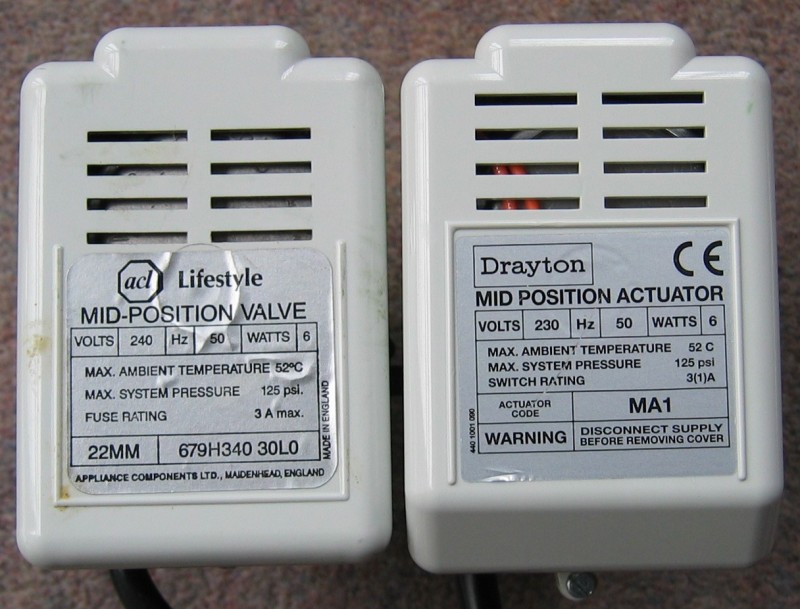
ACL (DRAYTON) motorised mid-position
actuators especially type MA1 (often type MA1/679-3) and similar types as shown in this
photo usually fail owing to a very small and unusual internal microswitch burning out.
This can be replaced, please enquire.
 |
More photos are here.
Email address: stevewozniak42 AT hotmail
DOT com
These actuators can usually be repaired. |
So predictable seem to be the failures of
some Sunvic actuators that their design may be called a minor environmental disaster. Tens
of thousands were probably manufactured, all may fail within a few years (some within
18 months) and most will be scrapped by plumbers who simply fit replacement units. If
properly designed, valve actuators should last 20 to 30 years - as Sunvic/Satchwell
Minivals used to do. An increasing number of failures are now being seen where the circuit
boards have exploded. The reason is that the 1801/1901 range of 'electronic' actuators
have proven to be extremely sensitive to even the slightest water ingress via leaking
valve spindles and the circuit boards were very poorly designed. Older designs of actuators are
unaffected by slight leakage, as is further explained below.
This section of the SeeRed website details why Sunvic motorised central heating valve actuators of a
particular design often fail to operate correctly. The main text applies to both modern
two-port and three-port (unishare) valves. These all have a similar design of electronic
circuit and regularly fail in a similar manner. These valves are not sold only under the
Sunvic name. For example, they are found in expensive Worcester-Bosch systems, as
this email has highlighted. These 'badged' actuators are also sold at curiously high
prices.
The popular Unishare three port valves are particularly prone to failure but can
usually be repaired quite easily. The two port designs simply fail to open reliably a few
months before they fail completely. Again, repair is usually straightforward. Spring
return valves (typically Sunvic 2301 and 2701 types and many variants of the same basic
design) can also often be repaired.
Fortunately, it is not usually necessary to drain the heating system to effect repairs
- all that needs to be removed is the valve actuator.
Failure can lead to low room or domestic hot water (DHW) temperatures. This in turn can
lead to other components such as thermostats and programmers being suspected of being
faulty. Hundreds of pounds are sometimes wasted in replacing components unnecessarily.
More seriously, faulty central heating controls can leave elderly people vulnerable to
the cold. Failure of these Sunvic actuators may be expected to be intermittent, at least
for several months if not longer, as electronic components gradually degrade. Old people
may not be believed when they complain about being cold - because when relatives or health
visitors call, the heating system may be working satisfactorily again.
A less common fault in Unishare three-port valves can lead to excessive hot water
temperatures - sometimes the motors run backwards! This is owing to gearbox grease
becoming 'sticky' with age and heat, and this is usually followed by complete actuator
failure - photos are on this supplementary webpage.
Again, it is a problem that should not occur, and especially not after only a year or so
of operation.
Supply of spare parts for Sunvic
motorised valve actuators. Updated March 2025.
I have a few spares available. Capacitors
for MoMo valves (1801, 1901 and similar types) can be supplied for £2.00 each, plus a
P&P charge of £1.50 (to UK) - so one capacitor will cost you £3.50
and two will cost you £5.50. Except for zener diodes and a few
microswitches, NO OTHER SPARE PARTS ARE USUALLY AVAILABLE. I may sometimes have a
second-hand part available if your actuator has an unusual fault.
I have never routinely sold the microswitches needed to mend many of these valves
because proper testing can be necessary to establish whether the switch needs replacement.
In particular, the internal circuitry of the SD2701 and related 3 port designs is quite
complicated and many faults stem from sticking motors and gearboxes. Two port 2301 and
similar types are simpler. Both types are prone to microswitch failure but usually only
after many years' service. It is often not worth mending a 2701 with multiple failed
parts.
For 1801/1901 and similar MoMo types, the capacitors must be X2 rated of a similar spec
to the originals. They will be 330 nF rather than the 220 nF that Sunvic used in earlier
batches of actuators - before they discovered that many of their actuators were failing so
prematurely. Be aware when fitting these that the old units may have retained some charge
- therefore discharge them before unsoldering. Also, if repairing an early valve with a
220nF capacitor, you will need to fit a 3.25 watt 24 volt zener diode to limit the relay
coil voltage if you fit a 330nF replacement. If you just want a 220nF capacitor I
have a few of these (same prices as above) - the actuator will operate reliably for less
time but no extra diode is required. In 2013/14 it was suggested that
widespread premature failures of X2 rated capacitors as used by Sunvic may have been owing
at least in part to poor quality manufacture of the capacitors themselves. A report from
ERA is available.
Note that capacitor failure here is quite different from that described on
this webpage - where the co-called Capacitor Plague of 2002 to 2010 is
discussed. These and similar problems with electrolytic capacitors affected (and
still affect) televisions, toasters, monitors, computers and other electronic
equipment including where switched mode power supplies are used (which these
days, is virtually everywhere!). The failures of the X2 capacitors in some
Sunvic and similar actuators is the result of appallingly bad basic circuit
design.
In purchasing spare parts you MUST be aware that repair of these valve actuators
is (of course) not recommended by Sunvic. However, for anyone well versed in soldering of
electronic components, DIY repair is a feasible proposition, provided you are wholly
competent in dealing with mains electricity and hobby electronics. If you don't meet these
criteria then get someone who is a 'competent person' to remove the actuator for you and
make the system safe.
Sometimes, the zener diodes that are connected across the relay coils have been found
to be almost 'short circuit' - in this case the DC voltage across the relay coils may be
as low as 0.2 - instead of 24. Failure of the smoothing capacitor (which sometimes goes
with failure of the rectifier) can be a factor also, but this is uncommon.
In one actuator I mended in December 2010 there was a most unusual fault - a high
voltage flashover had blown the relay coil and fried one half of the rectifier bridge. In
essence, a high voltage pulse had arced across from the thermostat wire to the low voltage
relay coil and returned to earth via one half of the rectifier bridge. I actually bothered
to clean up the pcb and renew all the components. The actuator was returned to a bemused
householder - who was left with the unsolved problem of why his heating system routinely
tripped out circuit breakers. In later years, the issue of exploding circuit boards became
more common as more and more valve spindles started to leak very slightly. In these cases,
for 1801 actuators, a new design can overcome the problem (see top of page). No such easy
option exists for the 1901 three port design.
All legal liability for any incompetent repair rests solely with the person who
undertook the repair. If you don't know what you are doing, then don't do it! Organisations
such as CORGI (now GAS SAFE) say that only 'competent persons' should ever try and mend a
heating system. In my experience, many of their so called 'qualified engineers' should
never have been let out of school, so poor is both their knowledge and workmanship.
Against that, many DIY repairs to houses are appalling!
It may be noted that the Sunvic company failed to respond to emails questioning the
reliability of products that were described in Sunvic sales literature as being very
reliable. Unishare three port (mixer) valves can fail in under three years - I have
repaired some that are between 1 and 2 years old. There is a good
technical reason why these popular Unishare valves are proving to be even less
reliable than their two-port alternatives.
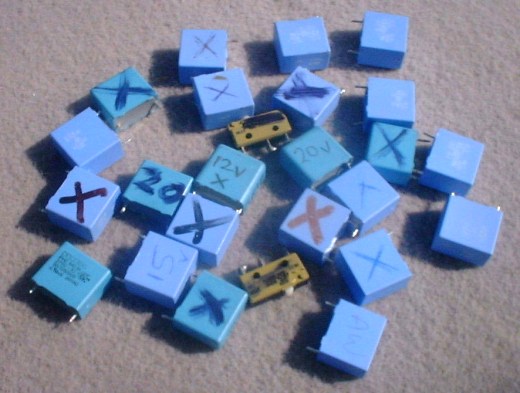
An advertisement for poor design. I now have hundreds of these! |
It is curious that even in 2008
and indeed also in 2010 and beyond, Sunvic were still apparently telling customers who
complained that they 'have had no complaints about these actuators' and are not aware of
any design faults. The original design dates to around 2001/2 but as early as 2003/4
Sunvic had changed the design to incorporate a larger capacitor and a zener diode.
The only reason for undertaking this design change would be to try to prolong the life of
the actuators before (premature) failure occurred. As it happens, the design modification
seems not to have improved matters very much, especially for the Unishare actuators.Here
are some failed capacitors, together with a couple of faulty microswitches. Probably
thousands of actuators are simply thrown away by plumbers. Sunvic have used capacitors
made by at least two major manufacturers. Both types seem to fail in the same way - so a
specific design or manufacturing problem seems to be ruled out. However the
problem may be related to inadequate capacitors as well as to problems with circuit
design, such as absence of a series resistor. |
Important safety notice: Motorised valves will most often be found as a
component of traditional central heating systems that include a hot water cylinder.
Increasingly, combination boilers are being used - especially in smaller houses and flats
- and these are both more complex and more potentially dangerous. Never alter any part of
a combination boiler system or a pressurised hot water system without seeking advice. The
usual use for motorised valves with a combination boiler will be for zoning of a large
central heating system (and using two-port valves). These can readily be operated without
the actuators in place.
Whilst repairing some types of Sunvic valve
actuators (and many other makes) is an easy job for anyone versed in electronics,
inexperienced people should not attempt this work. Some skill in soldering is required -
and remember these are mains operated devices. The usual precautions should be taken when
removing a unit from the mains wiring - including switching off the isolating switch-fuse
that should control the entire heating system and removing the fuse. In addition, check
that the system really is 'dead' after removing the fuse - I have known houses in which
live and neutral lines have been reversed even at the main distribution board (fusebox)!
Also, remember to make a careful note of which colour wire goes where - and if you are
removing two valve actuators, which wire from each actuator goes where! Do NOT attempt
this work unless you are experienced with mains wiring. With systems using two two-port
valves (usually, one for central heating, the other for domestic hot water control), you
may find that two orange wires, one from each valve actuator, are joined together - this
is normal. The two grey wires may also be joined (again one from each actuator) - these
are permanent live feeds to the two-port actuators, similarly the two blue wires (mains
neutrals). The two brown wires must be replaced in their correct positions - or you will
end up with the central heating controlling the dhw and vice-versa. Typical wiring
diagrams are shown in the Sunvic catalogue
(750k pdf file, allow time to download) - the diagrams are on page 17. Be sure to study
the right one!
The wiring of many central heating systems in the UK is undertaken to an appalling
standard (typical of the UK building and plumbing industries) so be prepared to find
shoddy work that needs rectifying. For example, it is quite common to find three port
valves wired up without a cylinder thermostat. It is all too common to find systems fitted
without a bypass loop and in system designs where one should have been fitted.
TWO PORT ACTUATORS: operating a
heating system without an actuator in place.
If removing a two port valve actuator, the
central heating can be left in operation by turning the valve spindle to the 'on' position
and using the time-switch or programmer to control room temperature in a crude manner.
However, it is also necessary to 'con' the boiler into thinking the valve actuator is
still in place and ordering heat. This can be done by temporally linking together
junctions within the wiring centre of the heating system - but again this may be fraught
with problems because (in my experience) so many are wired to a poor standard. Non-technical householders should not attempt this
work themselves. It is a matter of
linking together the two
terminals to which the BROWN and
ORANGE wires of the valve actuator were originally connected, if the thermostat is a type
that can handle the pump current directly. This has the effect of telling the boiler
electronics that the system is asking for heat. If you want to control the system
manually, link the terminals to which the ORANGE and permanent live (GREY) wires
were connected and simply switch the boiler on and off as required at the isolator switch.
This avoids possibly overloading the thermostat (BROWN wire).
The way two-port actuators work is as
follows: The BROWN wire supplies live (240 volts) from the relevant thermostat to command
the valve to open when the thermostat requests heat. The valve actuator should respond by
opening the valve and then signalling to the boiler and pump to switch on - it does this
by supplying 240 volts (live) to the ORANGE wire, taking this live supply from the
GREY wire.
If the Sunvic valve actuator controlling the dhw supply has also failed the dhw can of
course be operated also but the stored water temperature will approach that of the main
boiler thermostat (because the valve will no longer be controlled via the cylinder stat).
In these cases, to avoid the risk from scalding, turn down the main boiler thermostat to
about 55-60C. The valve can be closed manually whenever it is desired to stop heating the
DHW. All these procedures require some knowledge and competence and, once again, do not
meddle unless you understand what you are doing.
If the boiler and plumbing has been installed correctly (famous last words for the UK
plumbing industry!) and with a bypass loop, there should be no problem in closing both dhw
and ch valves manually if you wish to control the system in this way - the boiler will
then cut out on its own thermostat(s) (which it may do anyway during normal operation with
a light heating load) and the pump should run until excess heat has been dissipated via
the bypass loop. Again, there are many examples of poorly installed plumbing systems in
the UK, so ask an expert (if you can find one) to check if you are in any doubt about
operating your system without the valve actuators in place.
Three port valves:
Three-port valves operate in a similar manner but the wiring is different and some
valves are never installed properly by builders and plumbers in the UK. Some other types
of three-port valves (not the Sunvic type discussed here) are quite complicated
internally.
To operate the system without a three port actuator in place can sometimes be
accomplished by very carefully turning the spindle of the three port valve a little bit with a small pair of locking (molegrip) pliers and wedging it in an open
position. In its 'closed' position it will supply only dhw and the system should work
without the actuator in place at all - because none of the internal circuitry is utilised
for dhw-only operation.
Supplying 'live' to where the orange wire from the valve was connected generally
enables the boiler to light up and the pump to operate whatever type of valve has been
fitted, but there are issues of how hot each circuit will get if it is not properly
controlled - so turn down the main boiler thermostat to about 55-60C. Generally the orange
wire is made live within three port valve circuits when CH is required and the actuator is
instructing the system to provide central heating. It is made live for dhw via the
cylinder thermostat. But remember - don't meddle with electricity unless you know what you
are doing. You could kill yourself.
My personal recommendation for standard domestic heating systems has always been to use
two two-port valves, rather than one three-port valve. The much older design of Satchwell
Sunvic 'Minival' two-port motorised valves were renowned for their long trouble-free life
- I have some that are 30 years old and they are still working. Again, the appropriate
wiring diagrams are given in the Sunvic catalogue.
A common cause of failure is that the valves become stiff and this overloads the drive
gears in the actuator. The drive spindle of 2 port minivals should be free enough to be
turned around using only fingers. If it is not, try rotating it many times in either
direction using pliers. This can 'free off' scale inside the valve.
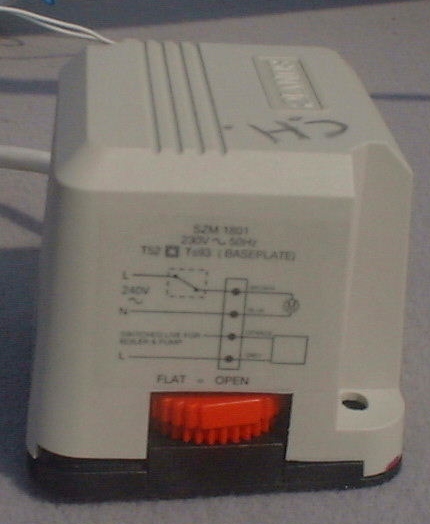 |
A view of the motor
unit SZM 1801 as used on a Sunvic two-port valve. Similar problems occur within Sunvic
three-port Unishare actuators. Indeed, the Unishare design is even more prone to early
failure than are two-port designs. Similar motor control electronics is used within
three-port Unishare valves, but some of the components are 'live' for longer, and so fail
sooner. This is disappointing because the basic design that lay behind
this innovative range of valves is sound - they are a direct wire-in replacement for
spring return valves that are a common feature of many domestic central heating circuits.
Spring return valves can fail via motor burn-out because the motors are energised all the
time the valve is required to be open - but they generally last much longer than these
newer Sunvic designs!
You can easily tell if a Sunvic valve of this type is 'open' or 'closed'. Just
look for the 'flat' on the red gear wheel - a good design feature. With Unishare valves,
the flat denotes the mid (mixed) position.
Removing the actuator head (the part shown here) could not be simpler - just
follow the instructions on the Sunvic leaflet (click here) |
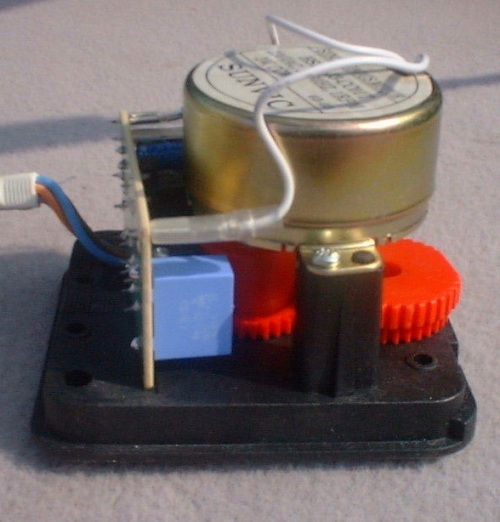 |
The motor unit of a
two-port valve: gear wheels (red) and the light blue capacitor which has proven to give
problems. This is X2 rated and replacements MUST be of a similar specification. X2
capacitors are usually used for suppression of high frequency voltage peaks across 240 VAC
lines. They are often used in situations where failure of the capacitor might cause a fire
- these capacitors are designed to fail-safe, although some problems apparently still
occur because their inherent self-healing characteristics can become compromised.
Where failure of a capacitor would lead directly to an electrical shock hazard
then an even higher specification Y class capacitor must be specified.
Failure of a microswitch can lead to these motors running for hours instead of
for a few tens of seconds. They then overheat and burn out. Sometimes hot grease leaks out
and jams up both microswitches! This is one of the more unusual modes of failure for these
supposedly reliable devices.
Gearboxes also fail - see below. |
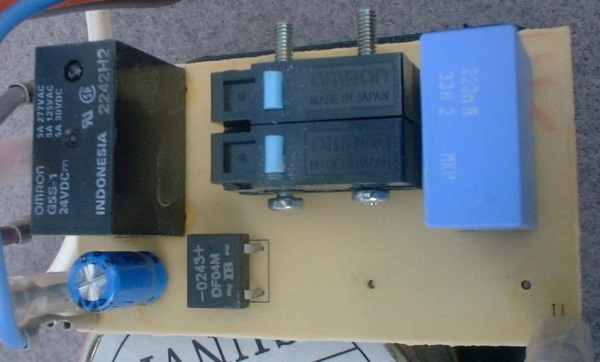 |
View of the two
microswitches that are operated by the red gearwheels. The electrical relay is on the left
- it is a 24VDC type which needs at least 17 to 18 volts to operate reliably. When the
large capacitor begins to degrade, the available operating voltage drops below that
necessary for reliable switch-on, hence the valves exhibit all the symptoms referred to in
my emails to Sunvic. I first suspected that either the microswitches or the relay itself
was at fault. The equivalent three-port designs are more complicated
having two relays and two sets of C1/C2 capacitors and rectifiers, three microswitches but
only one motor - all quite clever!
Repair and testing are not typical DIY jobs. More details of three port circuit boards and
their problems are here. |
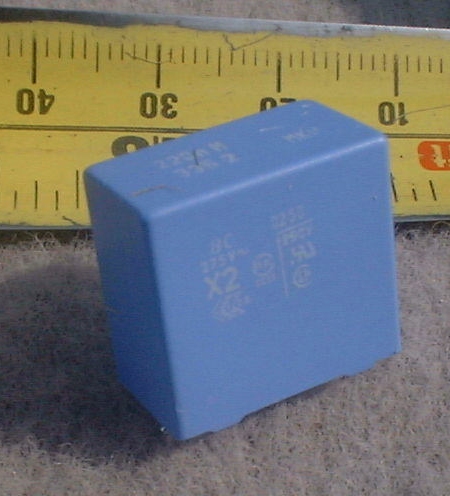 |
This is the component
that causes most of the trouble. The circuits used in these actuators are arguably a
poor design because partial failure of either of the two capacitors (or both of them) can
lead to a lower than acceptable DC voltages. This is a 220 nF unit from an early valve
(late 2003). One of the mysteries is why Sunvic used a DC relay
especially for the two-port design. Using a more expensive AC relay would have avoided all
the problems. There may be good reasons why the circuit was designed with a DC relay. Except maybe - that in the Unishare design - using ac relays
would have imposed significant cost and size disadvantages on the finished product. Low
profile relays of the type employed simply do not seem to be available with 240vac coils.
Safety note: whilst replacing these
capacitors is a trivial job for anyone versed in electronics, inexperienced people should
not attempt this. Some skill in soldering is required - and remember this is a mains
operated device.
Replacement capacitors MUST have an X2 rating with a 275VAC working voltage. |
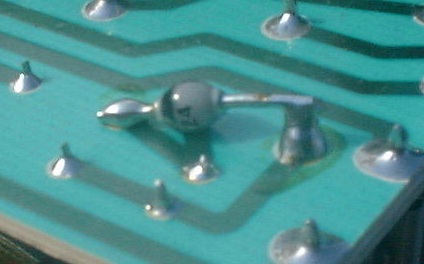 |
The zener diode fitted
in modern Sunvic valve actuators to limit back emf produced by switching off of the relay
coil - and to limit forward voltage. This modification (shown rather poorly soldered in
this example) may have been introduced by Sunvic in response to early valve failures
examined under warranty. Ideally, a diode would have been incorporated
into the pcb design: this 'afterthought' is hardly an advertisement for quality
manufacturing.
Other diodes found in these actuators are physically smaller and are BZX 24
volt types. If the diode fails the coil voltage may rise to about 30 - which may not be
too serious - or may drop to 0.2V - which stops the unit working at all. |
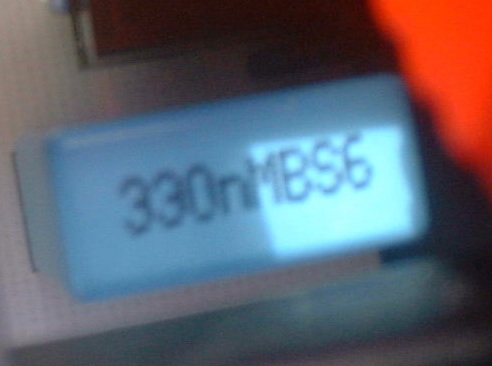 |
A 330nF capacitor is
fitted to modern actuators. Replacing a microswitch must be done very
carefully and using a type exactly equivalent to the original - with a 3 or 5amp 250 VAC
rating.
In one Unishare actuator I tested, a 330nF capacitor was so degraded the relay
voltage was only 9.8 - and the unit was less than 3 years old! In another, it was 12 volts
after only 15 months.
Sunvic appear to have changed the capacitors to 330nF to try to avoid premature
failures but to little avail - because whole idea of using X2 capacitors to drop mains
voltage may be suspect: a particular problem may be high temperatures of operation and
frequency of thermal cycling. Another
problem (highlighted in 2013/14) may be poor quality capacitors, and this seems to have
affected many electronics manufacturers.
It is interesting that most plug-in digital timers use an X2 capacitor to drop
mains voltage. It is a cheap way to produce low voltage DC if only a low current is
required. These units may have a larger zener diode and be more able to tolerate
degradation of the capacitor. The electronics may also be supplied via a voltage regulator
- so reductions in the basic VDC output may not matter too much. |
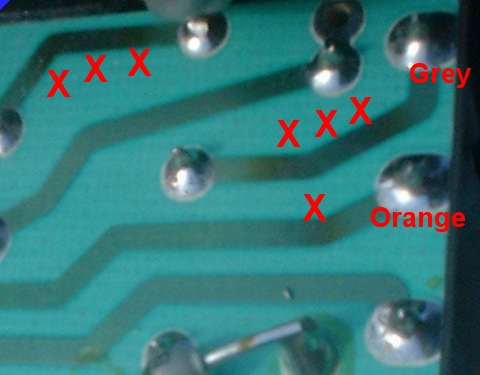 |
Overheating of PCB
tracks in a Sunvic actuator that failed because of a microswitch in which the points had
become welded together. This failure was caused by excess current: a
warm air system heater had been incorrectly wired with full fan current passing through
the valve actuator. A wiring fault of this type could result in a house fire - so if a
component fails in this manner, find out exactly why!
The tell-tale overheating and incipient blistering of the tracks (shown as XXX) is most pronounced on the track connected to the grey wire - which takes
the mains live supply into the valve circuits.
Discoloration of the track connected to the orange wire was slightly less
pronounced. |
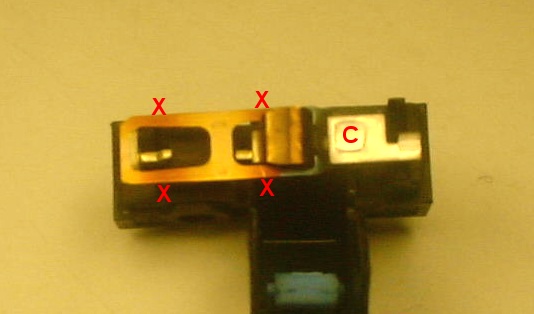 |
The inside of a
microswitch that had failed (with contact points welded together). The cause was
electrical overloading owing to a fault in a warm air heating system. A 3 amp fuse is usually specified for the isolator
of a conventional domestic wet central heating system. The contacts are underneath C.
Discoloration at regions X
bear witness to overheating.
If the contact points were the cause of the overheating (because of high
contact resistance) then discoloration would be expected primarily close to the points -
yet here it is just as bad on the left hand side. This suggests excess system current as
the primary cause of actuator failure. |
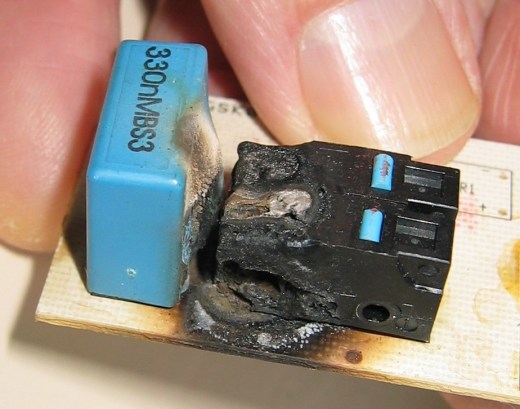 |
In this case however,
the circuit board has failed in a spectacular fashion, melting both micro-switches and
rupturing the 330nF capacitor. Although the reverse side of the pcb is
badly burned in the immediate locality of the switches, the tracks elsewhere are not
discoloured, and the system was fused at 3 amps. Excessive current is therefore an
unlikely cause of the failure.
In this example therefore, failure was likely owing to a high resistance
contact in one of the micro-switches - leading to localised overheating.
Similar problems are sometimes found within domestic 13 amp wall sockets as
well as (quite commonly) in Sunvic 2301 and 2701 actuators. |
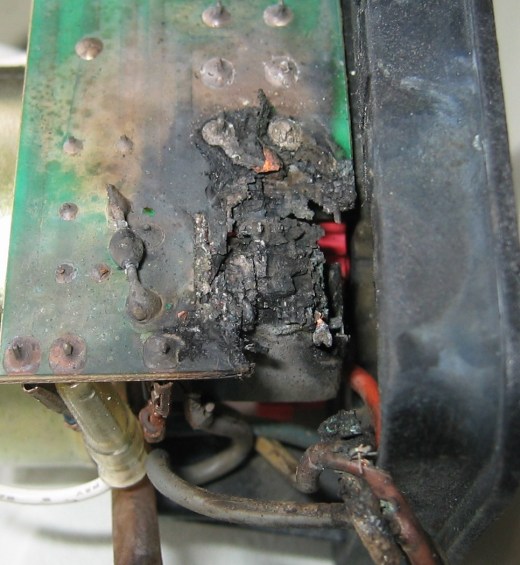 |
In this example, the
relay points and push-on connectors have overheated. This illustrates why actuators have
heat resistant housings. The temperature that was attained was enough to melt and burn PVC
and to char the relay casing and pcb - yet probably a house fire was unlikely. Despite
that such pieces of 'domestic electronics' may pose a low fire hazard it is maybe not a
good idea to smother them in blankets - as can happen inside airing cupboards.
It is surprising that this actuator did not go 'open circuit' and stop passing
current before the overheating became so extensive - but current would cease only when one
of the wires or contacts had completely oxidised or melted.
Moral of the story: never ignore a strange smell of burning from your airing
cupboard, or from under the floorboards!
This all shows the consequences of poor basic design - including perhaps tens
of thousands of repairable Sunvic actuators being scrapped.
Photographs of Unishare actuators that failed because of water leaking from a valve
spindle seal and because of poor quality control are shown on another page (click this link). In both cases,
short circuiting of high voltage to low voltage areas on the pcb caused components to
explode.
These and similar cases are not 'isolated incidences' - they are quite common. |
The full wiring circuits for two-port and
three-port valves are included in the following pdf page. This is taken from the patent website
describing these Sunvic valves.
pdf diagrams of wiring in Sunvic valves (use the zoom feature
of Acrobat to view the lower diagram clearly)
Also available is the installation leaflet for Sunvic SZMV
series valves and SZM 1801 actuators - strangely it states that it should not be left
with the user - yet these motorised valves used to be sold by B&Q and other
do-it-yourself superstores direct to end users! This leaflet includes the basic wiring
diagrams needed by installers.
Other companies in the plumbing industry are more open about their products - for
example, Triton showers are often easy to mend because parts can be ordered direct from
their website. However, like so many UK companies, Triton are increasingly buying in
components made in China or elsewhere overseas and no small spare parts are available -
only complete assemblies. I once had to mend a flow stabiliser valve in an electric
shower. All I needed was a simple 'O' ring to replace one that had perished. Triton
offered to supply a complete valve for £40. I used an O ring of slightly the wrong size
and it has worked perfectly for over ten years. 'Make-do and mend' has a lot to recommend it - but only if you
know what you are doing!
detailed explanation of failure of Sunvic MoMo
valves
why Unishare three port MoMo valves are less reliable
than equivalent two-port valves
water damage to the electronics of a Unishare
1901 actuator
photos of motor and gearbox failures in modern
Sunvic valves
home page