Folk dance moves and folk dance steps - participating in English folk dancing is even
easier if you first learn some basic moves and terminology. You will find it more
enjoyable if you wear suitable clothes - so advice is given. Updated September
2024.
These notes follow traditional dance teaching where men and women dance specific
roles. All traditional folk dances were written for men and ladies. The modern
craze is for 'gender neutral' dancing where anyone can dance any role. It is
popular amongst devotees of 'woke' culture, but makes learning more difficult.
It also makes dancing less enjoyable for a majority of people, especially as the
more complicated and/or interesting dances cannot be so readily called or
understood if the terms 'man' and 'woman' are not allowed to be used. This was a
particular problem at Sidmouth FolkWeek in 2024 - more of which elsewhere.
New addition to this website - April 2022 - an
idea to boost membership of folk dance clubs in the Devon area, and to raise
money for Ukraine during the early days of the war.
Target = £10,000 of which I would contribute up to £5000.
Comments welcome - but it will take you a while to read the document.
Please feel free to circulate the file (it may be updated quite often, so best to
link directly to the version on this website).
LINK = http://seered.co.uk/ukrainedance.htm
Teaching folk dance in
Devon - free instruction for beginners! But you get to organise the venue.
Despite not being a 'natural born
dancer' I have become quite proficient. My dance diary for 2016 shows how much fun and
exercise can be had for a few hundred pounds a year.
Highlights of my dance year in 2016 are here - see if they
encourage you to take up the hobby!
Since taking up dancing over 15 years ago I estimate I have danced about 45,000 times and
with hundreds of different women.
Principal links to folk dance material on this website.
The Covid pandemic put an end to folk dancing for almost two years. Only in late 2021
did many local clubs start up again. Some closed for good. Those that reopened have (for the most
part) been sensible enough to ensure good ventilation of dance halls, although
there have been all too predictable arguments between people who want to keep
warm and those who would prefer a healthy supply of fresh air.
 |
There are many 'online'
resources explaining the basic moves of folk dancing. However, there is also this 40 page A5 size booklet produced at
Cambridge for students new to folk dancing. Entitled "Elements of English Country
Dance" (that is included so Google will take notice), the ISBN number is 0
9519193 1 8
The usual cost is about £3 - don't pay
more to any on-line sellers.
Copies are available direct from the author
(Hugh Stewart), and in this day and age he might allow on-line orders, so you don't have
to spend £1 on a stamp to send a cheque.
Hugh's email address used to be Hugh.Stewart (AT) acm.org (replace (AT) by @)
It might still work. |
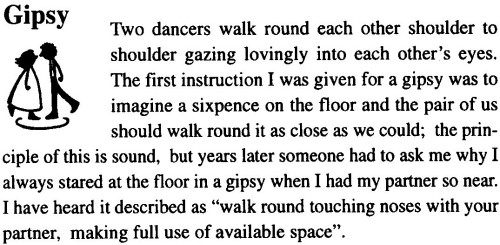 |
I've extracted the notes for the 'gipsy' move which
I dance 'according to the book' (well, almost) and which nevertheless gets me into trouble
both with over-shy dance partners and with particularly dour club organisers.
The booklet is amusing, very well written
and highly recommended (at least by me - but then again many people find my views on
dancing incomprehensible.)
For example I never 'sit out' a dance. Why
would anyone do this? |
So onto my own notes - this was originally one webpage but has now been split into
three. All the diagrams for Grand Square and related moves are
now here.
Diagrams and notes for double teacup chains are here.
Teacup chains for 4 couple square sets are still located lower down this page.
Some new square dances, one of them involving teacup and beermug chains are given here. First published October 2014
- over ten years ago!!
A display dance incorporating double beermug and double teacup chains is here - improvements are invited!
Again, first published October 2014.
A series of
webpages devoted to swinging and illustrating where dancers actually put their feet
during a buzz step (pivot step) swing. First published Sept 2015 and expanded October
2015.
Not sure what folk dancing is all about? Here are a few youtube
videos to show typical bands and dances at folk festivals in the UK.
Folk dance clubs in the UK are in decline - here is some
discussion of what might be done to revive them. The Covid pandemic led
to many small clubs closing for good and to reductions of 50% in attendance at
those that restarted. For many small clubs
especially, Covid was the 'last nail in the coffin'. Longer term, a sharp
reduction in overall disposable income in 2022/23 may deter some festival goers
and there may be lingering concerns about crowded and poorly ventilated venues.
These notes are based on those produced by several folk dance clubs. High speed
'thrashing about' on the dance floor is generally reserved for ceilidhs - where you need
to know what you are doing! Terms in
purple have special meanings and are used in dance
instructions. Learn what they mean!
What type of clothes are most suitable for folk dancing? - click here.
What is the best way to learn to dance? Find a really good dance partner to help teach
you. This applies especially to 'difficult' dances such as mazurka or polska. The polska
is amongst the most difficult of all dances to learn because steps for the man and woman
are 'offset' in time. To learn to 'swing' smoothly and properly either ask me to teach you
(my fees are very reasonable) or find someone equally competent.
Jean Baptiste Poquelin Moliere »
The Middle Class Gentleman » Scene II (first performed before King Louis
XIV of France in 1670)
DANCING MASTER:
All the misfortunes of mankind, all the dreadful disasters that fill the history books,
the blunders of politicians and the faults of omission of great commanders, all this comes
from not knowing how to dance.
"If people going through
divorce or relationship breakdown learnt to dance I believe this country could completely
turn around. I have saved two marriages by sending the couples to dance lessons. Many
marriages break down because couples have forgotten that sense of fun they had at the
beginning. Dance lessons are about £50 an hour; my fee is £285 plus VAT"
Divorce Lawyer VANESSA LLOYD PLATT's prescription for mending Broken Britain
Sunday Telegraph, 28 June 2009
A brief and
incomplete explanation of basic folk dance moves and steps
These few brief notes are just tips that I have found useful. There are
many websites showing videos of dance steps. Despite what purists may tell you, it is not
necessary to learn each and every correct step in order to enjoy 'village' folk dancing.
Many people muddle through - being on the wrong foot some of the time. So long as you get
from A to B at about the right time, you'll survive!
The three golden rules for folk dancers are that they should be in the
right place, at the right time, and facing in the right direction.
I always advise that first of all, you should learn the MOVES listed below
and worry about steps later. In partner dances such as waltz and polka, and in swinging,
steps really do matter - you do need to be on the correct foot at all times, or it will be
uncomfortable for your partner because you will be swaying in opposite directions,
and you may trip each other up. At
local 'barn dances', getting from A to B is all that some people ever manage - and they
can dance well enough not to annoy everyone else in the set.
It helps to know a bit about music - but it's not essential. Many very
good dancers are not musicians (and vice versa!). Generally dance moves take 2 or 4 bars
of music, 4 or 8 steps in English dance. A bar of music is generally about one second in length. A
32 bar tune lasts between 27 and 34 seconds. If 27, it feels very fast, typically
from a fast Irish Set dance band. Examples of dance moves that take 4 bars are stars, do-si-dos and
ladies chains (one way).
There is a difference between a step (=dance step) and other things you
can do with your feet. A step involves weight transfer from one foot to the other. It is a
definite move. However, in many dances it is required (for example) either to tap the
floor with a foot whilst maintaining weight on the other foot, or to lift a foot slightly
and put it down again whilst maintaining weight - these are examples of 'lesser' moves and
are not steps. I often call them twiddly bits. Depending on the specific dance, they may
be done either with the foot that has weight on it, or with the other foot. 'Twiddly bits'
can usually be missed out if you are learning a dance and it won't matter too much,
because you'll still be on the correct foot for when you next have to do a step.
The three-time waltz is one of the simplest dances. Other waltzes can be
much more complicated - even up to eleven time! A simple waltz is in three time. For men
LRL followed by RLR, for women RLR followed by LRL. In a ballroom waltz there can be an
equal emphasis on each step. In a folk dance waltz, there can be more emphasis on the
first step, thus: ONE two three, TWO two three. Here, 'emphasis' refers to distance
travelled rather than to how hard you put your foot down. A three time waltz can be danced
as one time, and folk dance waltzes are sometimes called 'one time' because there can be
so much emphasis on the first step of each group of three.
In any waltz, if you lose the timing the 'recovery mode' is just to
do the leading step of each group of three. When you and your partner get become
synchronised again, you can move seamlessly from one-time back to three-time. In a five-time
waltz which can be thought of 123,45 123,45 you can just omit steps 4 and 5 from each
sequence and do nothing! Because you are missing out groups of two steps, you will still
be on the correct foot when you come to do the next 123. What you must never do in any
dance is to miss out a single step - because then you'll be on the wrong foot. Doing a
five time waltz properly is quite difficult - and it is not best thought of as 123,45 in
any case.
A polka is strictly four time but is danced as three time with a pause (or
hop) on the first or fourth beat - there is no weight transfer and thus (as in the waltz)
the leading feet change from L to R and back again. Polka is usually taught as hop 123 and
sometimes as 123 hop. In practice it helps NOT to try and do much of a hop at all because
so many people overemphasise the hop and this spoils what should be the smoothness of the
dance. I tell people to think of polka as 123 glide through the air, 123 glide etc. In
practice that is what it feels like with a competent partner - the effort goes into
travelling around the room (often quite fast) and turning smoothly.
Missing a beat is very common - for example, in a Schottische the music
can be twelve beats but with only ten steps and the dance is often counted as 123 123
1234. In fact, it is 123 pause 123 pause 1234. Many people teach it as 123'and' 123'and'
1234 abbreviated to 123'an' 123'an' 1234 just because 'an' is easier to say. The pauses
can be slight rotations to change direction for the next 123, or indeed a hop. In mazurka dances missing a
beat is an important feature of the dance - again there can be twelve beats but only ten
steps.
Common sequences for a mazurka include: ma-zur-ka, 123, ma-zur-ka, 123
where the lift occurs on ka: the heel of the foot with the weight on it is lifted slightly
off the ground.
Thus for a man : L,R, lift on R, 1,2,3, R,L, lift on L, 1,2,3.
(Nowadays I always teach this as
step,step,lift, 1,2,3 step,step,lift, 1,2,3, and tell the woman clearly on
which sides of her body the lifts should occur.)
Other sequences (again for a man) include L,R, lift on R, L,R, lift on R,
1,2,3 (to rotate 180 degrees), R, L, lift on L. This sequence is then repeated starting
with two further groups of R, L, lift on L.
All of the lifts can be missed out and replaced by pauses when you are
first learning the dance.
Thus the sequence L,R, lift on R, 1,2,3, R,L, lift on L, 1,2,3 can be
replaced by L,R,P,L,R,L,R,L,P,R,L,R.
In waltz and polka, shoulders should be parallel with those of your
partner. The man's right hand should be holding his partner behind her left shoulder
blade, or slightly lower. The man's right elbow should be kept high - not allowed to droop down. He should
lean slightly backwards. Women should put their right hand behind the man's left shoulder
but should not press downwards on the top of his shoulder - and never put your hand around
a partner's neck.
Finally, don't be put off thinking 'I shall never be able to dance'. I am
not a natural dancer, I have little sense of rhythm, it takes me about six weeks to learn
things that some people pick up in five minutes, so if I can do it (and many women say how
good I am these days) anyone can do it - including you. But, like me, you may find it hard
going!
A summary of terms
used at English folk and ceilidh dances
The top of the set is always nearest the music
(the band or other source of sound!). In a longways set
the men will have their left shoulders towards the top, the ladies their right.
Sometimes a caller will deem the top to be elsewhere so that sets can fit into
the room better - typically when sets can fit better across the hall. In these
cases the top should still be defined so that the men's left shoulders are
towards the top.
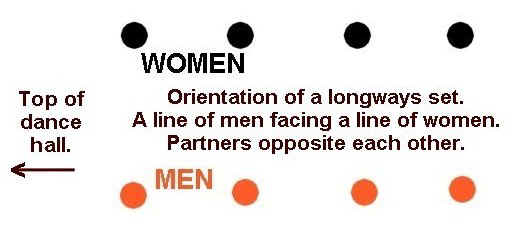 |
Longways sets can be for four
couples (as shown) or for any number of couples from 3 to 8. A longways set can also be
'for as many as will' meaning as many couples as wish to dance, all in one long set. |
When forming longways sets it is polite to join at the
bottom. Joining elsewhere can cause
chaos if the set has already taken
hands four (paired off into groups of
four people).
If you are told to move up the set or room you walk/gallop/promenade (or whatever)
towards the top of the set or room. If you are told to walk/gallop (or
whatever) down the set or room you move towards the bottom of the room.
This is obvious - move up towards the top and down towards the bottom. Or sideways of course - again obvious!
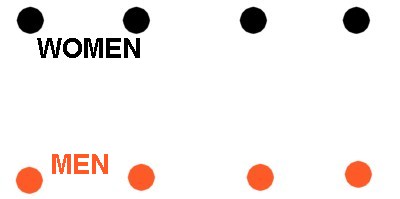
In all dances, unless otherwise told, ladies are always on their partner's right
(unless standing facing them). This is most important: ladies stand on the right of their
partner. More succinctly: WOMEN ARE ALWAYS RIGHT - this is something that married men soon
learn. In a longways set when couples turn to face the top of the set (or
"FACE THE MUSIC") they can once again hold inside hands (man's right hand
holding ladies left hand) in this default position.
Calls and
alternatives - and an explanation of how to do them.
Allemande Right or Left: otherwise known as a right or left hand
turn. The arm should be bent upwards and weight given to assist the turn. Often a turn is
once around, back to where you started. Sometimes it is a half turn, one and a half, or
two or more turns. In American Contra dance especially, it is good form to keep your
thumbs out of the way - they can get wrenched out of place! You should not grip the other
person's hand, the correct contact is better described as pressing hands together.
Back to Back/ Do Si Do: Face your partner and move forward passing right
shoulder, move across to the right (passing back to back) and come backwards to place. In
some dances the instruction may be for left shoulder - which can be called a see-saw move.
During these moves you should continue to face in the direction in which you started. More
advanced dancers can do spinning do-si-dos - they follow the same basic path on the dance
floor but spinning on their toes as they go, ideally glancing into their partner's eyes on
each synchronised rotation. This can be termed 'spotting'. If all else fails, just get
back where you started.
Balance/Set: Step to the right and step to the left twice
before a swing unless the caller tells you to do it only once. In a line it may be step
and hop on one foot and kick the other across, or a small step forward on your right foot
and back on the left, or holding your partners right hand stepping forward and back. When
the dance is in waltz time the balance is a swaying movement, forward and back, holding
inside hands with your partner. In American (contra) dance the balance is forwards and
back. A balance is generally a preparatory move: you will be told to balance AND swing or
balance AND turn single ("turn single" is just turning around on the spot
ideally using four steps, and usually clockwise).
Box the Gnat: A couple meet giving right hands they change
places with the lady going under their raised arms and turn to face each other still
holding hands, this means that they swap places and end up facing back the way they came
but still facing each other. Swat
the Flea is less common where
you use left hands instead of right.
Basket: In a circle of up to eight people, men with their
arms around the back of the ladies waists and ladies with their hands on the men's nearest
shoulder, pivot around to the left (clockwise). Not recommended if you have slipped discs
or other weaknesses - tell the other people not to be too violent. Done with some
enthusiasm at ceilidhs, the rotation can be quite fast. Ladies feet have been known to
leave the ground - this can be prevented (or made more difficult for men to achieve) by
the ladies leaning backwards. The rotation should be around a single point on the dance
floor, not wandering off in any direction, with right feet kept close in to the centre if
only four people are involved. In Irish dance a very similar move is called a Christmas
but all hands are kept at waist level - ideally, right hands around the waist of the
person on your right and left hands on top of someone else's right hand. This move is
occasionally reversed, then left feet act as the central pivot and the rotation is
anticlockwise.
California Twirl: Starting when couple are moving in the same
direction side by side, man's right hand to ladies left raising hands she turns left and
moves to his place while he moves a step forward and turns right and moves into her place.
You both end up facing the opposite direction and have exchanged places with your partner,
but still holding same hands. (Couples start and end this move both facing the same
direction as each other, and side by side.) Sometimes used at each end of a dip and dive move in a longways
set. The opposite (mirror image) move
is a Jersey twirl - and very rarely experienced. It was used in a Tom Hines workshop at
Sidmouth Folk Week in 2015.
Cast: Face up (or down occasionally) the set and move up
and around, away from the other line towards the bottom of the set. A double cast - face up the set and cast with your partner beside you all the
way around to the left or right using promenade hold.
Chassay: A sideways movement, either in a ballroom hold,
taking two hands or nearest hand moving to the right or the left.
Corner/Contra/Neighbour/Shadow: The person next to you who is not
your partner (therefore on ladies right or man's left). Will usually be of the opposite
sex.
Cross over: Cross over the set passing the opposite person
(often your partner) by the right shoulder and then turning to face back in.
Cross trail: Often used in square dances where one couple will
pass through a couple who are facing them but in doing so they cross over (lady going
first). Similar to part of a half of a figure
of eight move.
Cross-over
hey (reel): Common in a 3
couple longways set and sometimes used in a 5 couple longways set - as shown below.
Starts with lead dancers (in the middle of the lines of five) crossing over the longways
set with the lady going in front of the man (as in cross trail and figure of eight). Can be more complicated than shown below!
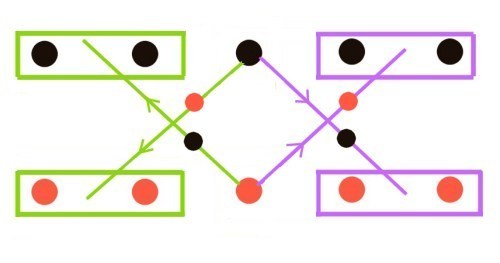 |
Each lead dancer will cross the set and do a reel with people of the
opposite sex (purple lines and boxes).
These dancers will then cross back to their own side and do a three person reel with
people of their own sex (green lines and boxes). None of the reels are 'complete' in this
example. |
Daisy Chain: This is an unusual but very satisfying variation of
a grand chain, and usually seen in a square set formation. It is a very 'busy' move with
many rapid changes of direction so dancers need to be alert and know what they are doing.
Especially, they need to keep an ordered formation. There is little opportunity for error
recovery because all dancers are moving all of the time.
The move was taught very clearly at a Tom
Hinds workshop at Sidmouth FolkWeek in 2015 - the instructions below follow those used at
this event. It was also taught, again by an
equally brilliant American caller, Will Mentor, at Sidmouth in 2023. The basic rules for a daisy chain are PULL,
TURN, TURN - repeated either 4 or 8 times to give a total of either 12 or 24 moves,
usually only 12. Each
sex of dancer must be clear there is a forward direction for them (as in a normal grand
chain) and a reverse direction (clockwise for men, anticlockwise for women). Each PULL
move is in a forward direction, as in a simple grand chain. Every first TURN leaves dancers heading in their reverse
direction. The definition of TURN in a daisy chain is turn the dancer
you are facing by 180 degrees AND then pull or dance past them to meet another
dancer. Every second TURN leaves dancers heading forwards again, ready to do their next
PULL move. That's all there is to it!
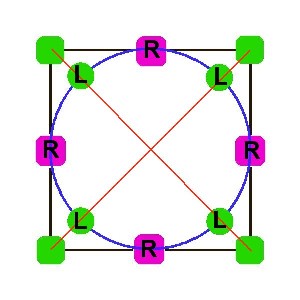
In a square set dancers start either side of
the purple squares. In a grand chain figure dancers pull by
right hands at the purple locations and left hands at the green locations. Dancers should
be taught to do a precise grand chain before moving on to try a daisy chain. |
First, teach dancers how to do
a simple grand chain properly. Emphasise that right pull-bys occur on the sides of a
square, and left pull-bys at the corners of the square. In this diagram the basic outline square is shown black. The
small purple and green squares are where pairs of dancers interact - doing turns or
pull-bys. Although the formation is a square, in a grand chain it soon becomes a circle
(shown blue) so the green squares effectively move inwards a little (and I've shown them
as circles). So, dancers give right hands and pull by at each purple box, and left hands
in each green circle. There are 8 hand changes to get home. In strip the willow in a
square there are 8 turns to get home (and only the purple locations are used, in addition
to the centre of the set).
In a teacup or beermug chain there are only
6 essential moves (more can be added to use up the music) and again the green locations
are not used. But in a full daisy chain dancers interact at both purple and green
locations and there are 24 moves to get back home - so it's busy! |
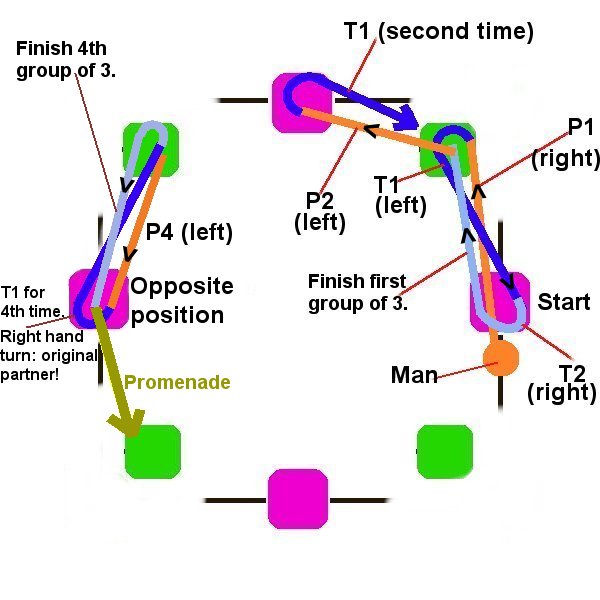 |
This shows the path taken by a
single male dancer in a daisy chain. His first move is orange - a right hand
pull-by (P1) with his partner. This takes him to the green location where he
does a left allemande turn (T1) with a woman who will be coming towards him.
T1 (dark blue) leaves him heading back in a reverse direction to his home
(start) location where he should meet his original partner for a right
allemande turn (T2, light blue). He then heads back in his forward direction
to the green square. He shouldn't meet his partner again for quite a while. Once back at the green square, he does a left pull-by (P2) with
another woman. This sequence (orange, dark blue, light blue) is then continued but is not
shown until P4 (a left hand pull-by), which leads into a right hand allemande T1 turn with
his original partner half way round the set. It is a common mistake to think this fleeting encounter is the end of the
sequence. He then leaves his partner for a few seconds
to reverse direction (up to the green square), then he does T2 for the 4th time (left hand
and light blue) which leaves him taking right hands once again with his partner. At this
instant, there can either be a continuation of the chain for a further 12 moves, or a
simple promenade around half the square back to home place. Once perfected, you wonder why
people find a daisy chain difficult. It goes wrong when dancers lose orientation owing to
the set having become sloppy (out of shape). I have known it taught badly, in too much of
a rush. All you need to remember are the three magic words - pull, turn, turn, and that
each pull is in your forward direction and that each turn move includes
dancing past the person who you have just turned . Each pull/turn/turn sequence takes around 6 bars,
maybe 5 bars if you are very quick doing the pull move in one bar. |
Dip and Dive: Used most often in longways sets, but can feature
in circles, typically double Sicilian circles (two couples facing two couples). Couples
approach each other holding inside hands. One couple arches, the other couple dives under
the arch. The 'active' couple who start the move may dip and dive under and over each
couple all the way down a longways set until they get to the bottom. Each of the other
couples may only be 'dipped' or 'dived' once. However, often the move is continuous, as
couples reach the end of the set they turn round and start 'dipping and diving' in the
opposite direction - thus everyone eventually gets back where they started (as in a full
reel). When used in a circular formation, every couple starts at the same time (and you
will be told which couples arch first). Maintain inside hand hold with your partner at all
times except when turning around at the end of a longways set (but if you do a California twirl at the end you get to hold hands here too). Sometimes
dip and dive is danced so fast there is hardly time to do a California Twirl at either end
of the set.
Dolphin
Reel: Similar to a normal
reel (see below) but at least one of the 'people' in the reel is comprised of two people
who travel together, one closely behind the other, and at each end of the reel they change
who is in the lead. The simplest example is a three person reel which is actually danced
by four people - two of them acting as one person. The changeover at each end is effected
by whoever is in the lead (of the two acting as one person) taking a slightly wider arc to
turn around, allowing the 'follower' to take an inside track and nip in front - thus
becoming the lead person until they reach the other end. An alternative way of explaining
this is to say that as the two people acting together reach either end of the reel both of
them simply turn around 180 degrees on the spot.
Dog-leg reel: An
unusual move seen in longways sets for four couples with 3 and 4 improper. I'll add a
diagram shortly! I had been dancing for 10
years before I met one of these!
Figure of eight: You and your partner dance a figure of eight
around another couple. Leading through that couple (lady goes first) crossing with your
partner, go round behind the person who was next to your partner and into your partner's
place, (this far is a half
figure of eight). For a full figure of eight you continue, crossing again with your partner to
get home - ladies first in the crossing, as before. This can be made more interesting (=
more difficult....) if both couples do a full figure of eight at the same time.
Effectively you all travel on the same paths as before but there are no people standing
still that you can go around - they have moved and are doing their own figures of eight. A
double figure of eight usually starts with one couple crossing up (or down) through the
other couple who are by that time casting out into first (or second) position to start
their own figure of eight. The call is generally "first couple cast, seconds cross
up" or "first couple cross down, seconds cast" - or similar. Both couples
cannot start to cross at the same time - hence one has to start by casting which
introduces the delay necessary to avoid collisions.
Grand Chain: Move around the set by passing right hands with
your partner, left with the next, right with the next, etc. (Men go anticlockwise, ladies
clockwise). Start by facing the person you are dancing with (often your original partner)
give right hands and pull by each other (passing right shoulders). Someone else should be
coming towards you with their left hand outstretched. Weave the ring is a right and left grand chain but without touching hands. A wrong way grand is simply a grand chain but men move clockwise and ladies
anticlockwise. There is also a running set move called 'rights and wrongs'. Going
completely around a square set in a grand chain takes 8 hand changes and can be danced in
8 bars (about 8 seconds). In Irish Set dances typically 12 bars are allowed, because each
hand change is done in 3 steps, so there are 24 discrete steps.These dances often have
'step it out for 2 bars, chain for 12 and step it out for 2 bars' as a 16 bar sequence.
Also there can be 'chain for 12, swing for 4', again a 16 bar phrase of music. English
dances (and dancers) don't often bother with discrete steps, they just chain around, and
can do it easily enough in 8 bars.
Grand Square - and the related moves grand rectangle, grand
sweep and grand triangle are explained in detail here.
Grimstock
Hey: Danced for three
couples. It is essentially two sets of three-person reels side by side but synchronised,
with couples holding hands when they can across the two reels. Easily explained with a
diagram! Very easy to do if you think of it just as a 3 person reel (and if everyone else
is in the right place). Because these are 3 person reels (see Reel/Hey below) at one end it will be right shoulders, at the other end,
left shoulders. Stay on your own side of the set, in the reel in which you started! A
Morris Hey is the inverse of a Grimstock Hey - you come together in the middle rather than
push away from each other. A Morris Hey usually starts with a couple at one end casting
out and coming together in the middle of the set, the other people then join in.
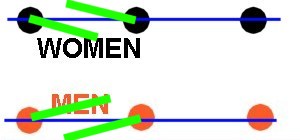 |
Start of a grimstock
hey. 3 couples each holding hands, 1s facing down, other two couples facing up. The lines
of both 3-person reels are shown as blue lines. Middle couple push away from each other,
drop hands and move outwards up the set (green lines) whilst top couple move down the set
(also green lines). Third couple then join in as the original tops push away from each
other, drop hands and move outwards to reach the bottom of the set. And so on! |
Gypsy: Two dancers walk around each other shoulder to
shoulder gazing into each other's eyes. Can be in either direction but usually rotating
clockwise (right shoulders adjacent). Often 'melts down' into a swing - you will already
be rotating in the correct direction if told to do this!
Half Pousette: A way for two couples to change places. Hold both
hands with your partner as though for a two hand turn (but not crossing over your hands)
and one of you pushes to move forwards while the other moves backwards, the move should be
on a diagonal towards the other pousetting couple and having moved a double out (two steps out) you fall back diagonally into the other couples place. To do a full pousette you keep moving so you get home (back
where you started from) having gone around a complete square. There is also a similar move
called a draw pousette.
Half/Full right and Left
through: Danced by two
couples, frequently facing across the set to your partner, but sometimes facing up and
down the set. Each person moves along typically 2,3 or 4 sides of a square. Facing as
directed you change places with the person you are facing giving right hands as you pass
(by right shoulders), then turn to your neighbour on the side and change places with them
giving left hands acknowledging them as you do so, do not turn your back on the person
with whom you have changed position (this is known as a courtesy turn). Full R & L through face across again giving right across and left on
the side to finish up where you started. This move can be danced without giving hands,
just passing right and left shoulders - as seen in several Irish set dances.
Hey: American term for reel.
Home: (home place) : where you started the dance.
Improper: Starting the dance on the opposite side to where
you would normally, i.e. man on the ladies side and the lady on the men's side. In a
longways set this could be couples 1 or 2, in longways sets it could be couples 1, 3 and
5, or couples 2 and 4 etc. Sometimes the 'men's line'
will be told to do something despite that it contains ladies - the men's line is the one that originally had all the men in it......In a
longways contra dance all first couples (couples 1,3,5,7 etc) will swap sides to become
improper. In a few dances it is the second couples who swap sides - the formation is then
called 'indecent' rather than improper!
Ladies Chain: Couple facing couple, the ladies give right
hands to each other and pass to give left hand to the opposite man who helps them turn
around (anticlockwise), the ladies give right to each other again, then left to their
partner who also helps them to turn round (again anticlockwise). Ladies may put their
right hand behind their back, to be held by the man's right as he sweeps them around.
There are many variations of this move - all end up with a lady standing on the usual
right hand side of a man - so if all else fails, just get there! Ladies get most of the
exercise in these moves. Sometimes men are required to give the ladies an additional
'power turn' as they come out of the chain. This involves turning them around on the spot
quite rapidly either a half way or fully round. In all cases the men should
first slide to their right (into their partners place) so as to be able to
receive the other lady's left hand as she comes across the set on a diagonal.
The man then travels along an arc back into his own place whilst turning the
lady into hers. Good dancers will add spins - so that the lady spins on her toes
as she moves back to place. The invitation to do this is that the man will lift
the girl's left hand as he takes it (left in left), if the girl accepts the
invitation to spin she will allow hr hand to be raised. (If not, not!). Fast
dancers can do two spins, sometimes three.
Mans Chain: Couple facing couple as above, men give left
hands to each other and pass to give right to the opposite lady - etc. It is the mirror
image move to a Ladies Chain - the direction of rotation is now clockwise.
Sometimes a dance calls for a man's chain with men giving right hands.
Morris hey - see Grimstock Hey above.
Pass through: Walk forwards
past the facing dancer passing usually by right shoulders.
Promenade Hold: Standing side by side with your partner,
facing in the same direction, holding hands across in front of you, right to right, left
to left, usually with right hands above left hands.
Promenade: Holding hands as above. In a circular or square
formation usually the promenade is anticlockwise around the room or dance set (sometimes
called Ballroom direction) which means the man is on the inside and the lady on the
outside. A half promenade applies either to square sets,
or a longways set, where you promenade across the set and then turn
as a couple to face in.
Reel/Hey:A weaving figure, dancers moving by passing
(usually) right shoulder first then left shoulder along the line, when you get to the end
you turn around (counting that as passing someone) and work your way back. Often causes a
great deal of trouble but is very simple once grasped! It is essential to think of a reel
as being danced in a straight line - albeit a wavy straight line. It is also essential to remember you turn around to change
direction ONLY at either end of the reel, never when you are in the middle. These rules
can be adapted (i.e.: broken) for more complex reels, such as a push-off hey! (Also
Shetland Reel ; Cross-over
Hey (reel) ; Grimstock Hey ; Dolphin
Reel ; Dog-leg reel)
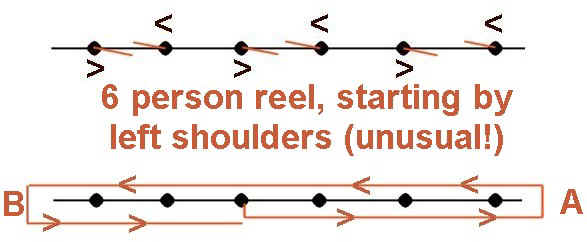 |
Start by facing as shown (> or <) and dance in that direction. Pass
(usually) by right shoulders first with the person you are facing. The third dancer will
weave in his/her starting direction to the end of the set (A) then all the way to B, then
back to his/her starting position. Everyone will dance twice the distance A-B. |
ALWAYS be clear which line is being danced
- and with whom, as there may be several options - listen to what you are told to do!
Often, start by facing your partner and passing right shoulders.
Pass the next person left to left, then right to right, etc, all the time moving in the
same direction.
At the END of the line of dancers who are 'reeling', you turn around (loop back) and on
the way back pass the first person coming towards you with the same shoulder as you passed
the last person before you looped back. Simple when you get the hang of it, and often
danced quite fast. Think of it as passing right/left/right/left/turn/left/right/left etc. Some callers say you turn with a ghost person at
each end of the line - this is just another way of explaining that you come back in with
the same shoulder or hand that you went out with - having used up one move with the ghost.
Reels can be for as few as three people or for many more. More complex reels includes
dolphin reels and grimstock heys (explained above), Shetland reels (explained below),
push-off heys and Morris heys, all of which are easy if you practise them often enough. In
contra dance a hey is just a reel - a different term for the same thing. The term 'hey' is
apparently from French dance, a long time ago. Some American callers will say "hey
hey hey" - this just means do a reel. Reels that are diagonal or intersecting often
give the most trouble: the rule is the same - make sure you know which straight line is
involved.
I always explain that if there is an even
number of people in a simple reel (4,6,8 etc) then whatever happens at one end happens at
the other (right/turn/right OR left/turn/left at both
ends). If there is an odd number of people in the reel (3,5,7 etc) then at one end it will
be right/turn/right and at the other it will be left/turn/left.
In many reels, everyone starts and ends at the same time. But this is never
true of a three person reel - one of the dancers has a time delay to start and
also to finish. You can only start a reel if you have someone to face and who is
coming towards you. Otherwise you stand still and wait!
Reels on the diagonal of a set can occur simultaneously and interactively - in this
case a star is danced in the middle. The diagrams below give the general idea. It is
ESSENTIAL to remember which reel you belong to at any one time - as the dance progresses
you may become part of the other reel!
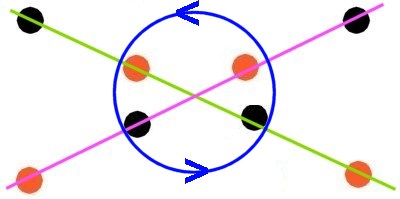
The first diagram above shows a simple four
couple longways set. There are various ways to change this into the
formation shown in the second diagram. Two diagonal reels can now be danced at the same
time, one along the green line, one along the purple line. Dancers belong to one or other
reel until it is completed. Everyone passes right shoulders at the corners of the set and
does half a left hand star (for four people within the blue circle). A dance
with simultaneous but parallel diagonal reels is shown below. These are independent reels
- each group of three people does not interact with the other group, unlike in the example
above. This can be made more challenging by making dancers do three quarters of a star
each time, rather than half a star: dancers then spend time fleetingly in each reel,
green, purple, green etc. and they progress around the set visiting each corner in turn.
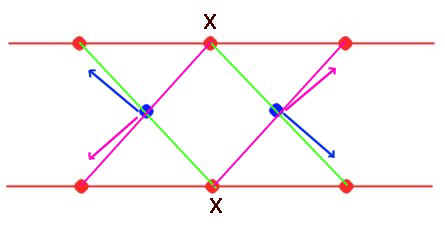 Another example of a dance with diagonal reels is
Eight of Hearts, a dance for eight people (no partners and gender doesn't matter). Part of the sequence is shown above. If taught
properly, the whole dance is easy. If taught badly, it quickly degenerates into chaos
because there is so little recovery time.
The dance formation is three people facing
three people (shown red) with two standing back to back in the middle (shown blue). |
The dance is led by the blue
people but the two red dancers at X and X have the most difficult role - they have to
decide very quickly which diagonal reel they are in! This is easier than it looks - if the
caller says 'right reels' this is an instruction to the lead dancers, so the dancers at X
simply look in the opposite direction - diagonally to their left. The blue dancers start
a pair of three person reels (green lines) by facing to their right and passing right
shoulders (blue arrows). Immediately the green reels finish the blue dancers face left and
start the purple reels (purple arrows).
Dancers at X and X need to keep awake: they dance the green and purple reels with
different people. So do the blue dancers - but they are in charge and this makes life much
easier! Each set of reels involves only 6 people - the other two stand still. |
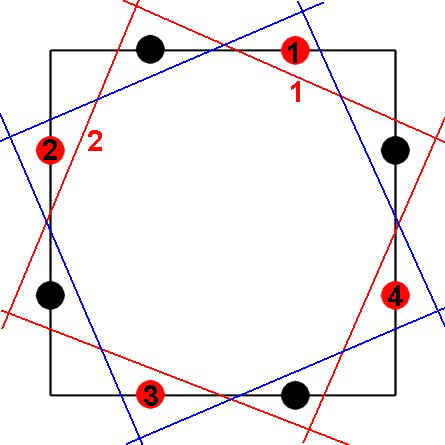 Men
reel along the red lines, man 1 along red line 1, and so on. Ladies reel along the blue
lines.
Throughout these reels, dancers interacting with each other are NOT reeling along the same
lines.
|
In a square set,
interconnected three person reels (figures of eight) can happen simultaneously. It looks
complicated on paper!
Men are denoted by red circles (with numbers 1 to 4). Ladies are black circles and are
standing beside their partners in a simple square set (black square).
The key to it is to remember that each person does a three person reel ONLY with his/her
partner and his/her corner - and with no regard for who else their partner is interacting
with.
Each couple will start by facing their partner and passing by right shoulders before
turning around - each having reached one end of their reel. Once they have in effect
turned around each other (passing right shoulders again) they finish their respective
three person reels in different reels (along different lines) before returning to their
home positions.
Thus man 1 will reel with lady 1 (his partner) and lady 4 (his corner). Similarly, lady 1
will interact with her own partner (initially) and then with man 2.
In practice, it's remarkably easy! And even easier if you forget the complicated
explanation and just do a right shoulder gypsy with your partner followed by a left
shoulder gypsy with your neighbour. |
Right or Left Hand Stars: Usually danced sedately by two couples. Give
right hands across holding the opposite person's hand, or left hands for a left hand star.
Again giving weight will help. Sometimes all the men or all the women (3 or 4 or 5 or
more) in a set will be required to do a part or whole right or left hand star - and
sometimes as they sweep around they 'scoop up' their partners (or another person) putting
arms around waists. The people being 'scooped up' are usually ladies and they should put
nearest arms on the shoulder of the man who has (in some fast dances) almost swept them
off their feet. This is (of course) never done intentionally. When two men are holding
'hands across' on a diagonal with two women in the other diagonal it is usual for the
men's hands to be beneath - supporting the women's hands on top.
Shetland
Reel: identical to a
normal simple reel except each 'person' is now two people, one following closely behind
the other. Therefore, a '3 person' Shetland Reel would involve 6 people - but they act as
though they were only 3, each couple being an entity.
Sheepskin hey: only
ever used in one 3 couple proper longways dance as far as I know (Picking up sticks),
diagram to follow. Once you've understood it, you wonder why so may people find it
difficult! It's just unusual.
The three women stand still, and watch (they will be doing it next!). The three men
follow each other (top man in the lead) going around the top of the set and weaving down
through the standing line of women. When the third man comes to the middle woman he loops
back around her (effectively he travels all around her) and so becomes the lead man but
now heading back up the set (towards the top). The other two men continue doing their
figure of eight around the three standing women. When the second man (who will now be at
the end of the line of three men) comes to the middle woman he too loops all around her
and becomes the lead man - and heading back down the set. Then it is the turn of the
original first man to be 'last in the line of three men' and he loops around the middle
woman (to head back up the set) and then around the top of the set (around the top woman
actually) and only then straight down the outside of the line of women and back to
original places, looping around the bottom of the set. Then the women do it (only better).
Everyone should then be back where they started the sheepskin hey.
Square Through: This is similar to right and left through but
without any courtesy turns, and especially without the final turn, but can be danced more
quickly. A left square through
simply starts with left hands - but is rare. Lack of the final turn leaves you facing in a
different direction (90 degree out) than if you were doing full or half right and left through moves.
You can square through 2, 3 or 4, being the number of hands you use (also the
number of sides you walk) - these moves are very common in American Square
dance.
Star Ladies Chain: Ladies move halfway around a (square) set in a
right hand star. The opposite men give them their left hand and turn them around into
another right hand star to return to their partners, who turn them in the same way.
Sometimes, instead of going half way round in their star, the ladies go 3/4 round - and
sometimes as they are rotating in the star (in the middle of the set) the men nip smartly
around on the outside to another mans place. It is rare (but possible) for men and women
to swap roles with the men being 'chained out'.
Star Through: With a man facing a lady he holds up his right
hand (like a policeman stopping traffic) and she holds up her left so they touch palms.
Each moves forward, the man turning right after passing her and the lady left after going
under their raised arms, the couple end up holding hands both facing the same direction
(compare with California Twirl and Box the Gnat which are both quite different). All three moves achieve a rapid change
in position and/or orientation of a dancing couple.
Strip the Willow:
Great fun, and often danced very fast at ceilidhs and with fast turns - especially if
everyone knows what they are doing......! The end couple turn each other by the right
(with an elbow hold keeping thumbs tucked under) once and a half to get to the other side,
then turn the next person on the side by the left, go back to their partner for a right
turn (in the middle of the set), the next person on the side by the left and so on to the
bottom of the set, turning everyone of the opposite gender on the side by the left and partner by the right. At the end the working
couple need to turn half (or once and half) to end up on their correct side.
Remember the golden rule - right to your partner in the middle, left to everyone else
on the side. Sometimes a half strip the willow is danced first - whilst one of the
'active' couple turns each person in the opposite gender line by the left (and partner by
the right) as usual, the other simply walks sedately down the middle of the set doing only
right arm turns. On the way back the roles are reversed.
Strip the Willow can be danced in a square formation - easy if everyone remembers that
their 'number one person' is to their right, their 'number two' is opposite them and their
'number three' to their left. Everyone's number four is their own partner - see below!
There are eight arm turns to complete the move. The easier way of remembering where to go
next is the rule 'always diagonal right' - the next person of the opposite gender that you
will interact with is always the one to the diagonal right of your current position. This
rule applies also in simple teacup
chains (see below).
Strip the willow in a circle
(square formation) two opposite men start by turning 3/4 by the right,
left to their 3/4 lady (the one who was diagonally to the man's right), by the right in
the middle of the square (two men again), by the left to their respective 1/2 lady
(opposite where the men first started) and so on back to their partner. All the right arm
turns are in the middle of the set (with a same-sex person) and all the left arm ones on
the sides (with an opposite-sex person). Can
be very fast and can be danced six times through - head men leading, side men, head
ladies, side ladies all the men together, then finally all the ladies together. It is a
good idea to know this sequence off by heart before attempting a teacup chain! The similarity is that
each 'active' dancer interacts in turn with each member of the opposite sex going around
the set in an anticlockwise direction. Once this pattern becomes ingrained, a teacup or
beermug chain for four couples is easy.
There are other versions of Strip the Willow one of which I pinched from an Irish dance
- it has only seven arm turns to get back home. The Irish caller was explaining the move
as follows - turn this person, turn that person - then he said "and now you get to
have the one you haven't had yet". Within his usual innuendo and banter, I christened
the last two people to be turned as the actress and the bishop. It's danced in square sets
with each couple leading (the other six dancers stand still). Turn partner by the right,
turn corner (your own corner) by the left, partner right, opposites left, then right
1.25 turns with partner to go to the one you have not had yet - on opposite sides of the
set - then right arm to partner to move back home. It fits 16 bars quite nicely because of
the longer than usual right hand turn.
Swing: Stand
facing your partner so right shoulders are in line, or a little distance apart, place
right feet side by side outside your partners to act as a pivot, then use your left foot
to push you around similar to riding a scooter in a clockwise direction giving weight as
you do so. Various arm holds are used, the most common is a variation of ballroom hold.
Cross hand hold (or preferably arms around waist) is used for some dances e.g. hornpipes. It is important that both
dancers respect their partner's capabilities when swinging and ensure it is safe to
release the hold before doing so. Can be very fast and some ladies may get
seriously giddy - men should not let go until they know it is safe to do so. With
practice, the man's left hand and the ladies right can be free - the only real contact
being the man's right arm firmly around the ladies back (preferably some distance above
the waist) not pulling her towards him but offering firm support. Imagine you are rotating
around a point on the floor - do not move sideways in any direction. At the end of a swing
the lady should be on the man's right and facing in the same direction. All swings can be
done at a greater rotational speed if the dancers keep close to each other - holding each
other far apart means that a lot of rotational energy has to be built up for a given
angular velocity. Another mistake is to allow your body weight to bounce up and
down. This expends energy - because the up and down motion is not completely
elastic!
Very few folk dancers are excellent 'swingers'. The key rules are: keep both feet close
to the ground, keep your feet close together, dance on the soles of your feet
(or even your toes) as much as possible (your
heels should never touch the ground during a swing), aim to do lots of small steps, keep
upright and keep close to your partner, unless you know what you are doing and are showing
off. The most common mistake (apart from having feet in completely the wrong places) is
for people to orient their feet with toes pointing inwards to the axis of rotation. Toes
should lead forwards, around the circle! Many times (including at IVFDF 2015) I have
corrected girls who are doing this and they say "oh is that how you're supposed to do
it!". In a simple one minute lesson, their swinging can be transformed. In the UK a
'buzz step' or 'pivot step' swing is the
default method, whereas in contra dance in the USA a walk step is commonly taught. More on learning to swing properly on these webpages.
Fast dancers may do optional spins at the end of a swing (as they may do spins
during the last part of a ladies chain) - a superb example is given in
this
2018 youtube video of a contra dance called by Will Mentor in the USA. At
time 2.19/2.21 watch the girl in the light green top, multicoloured skirt, and
bare feet.
Note how close together her legs and feet are! She may well be a ballet dancer -
her skirt is ideal in that it spreads out to show how good she is. Flared skirts
are also ideal for spinning!
Teacup Chain:
(includes alternating teacup chain). Diagrams for the double teacup chain are now here.
There are several variations of a teacup chain. All are in a square set with (usually)
the men staying in their original locations. Most often only girls do teacup chains. In a
few dances men do the mirror image move - a beermug chain. A new display dance using both
double teacup and double beermug chains in here. A simpler
dance (with an alternative much harder version) and involving a single teacup and a single
beermug chain is here - please do try this at your club and let
me know how you get on!
Simple teacup chains take only 6 arm turns to get back home - compared with 8 arm turns
in 'strip the willow in a square' - thus if a 16 bar phrase is used there is too much
music, but if all dancers do a complete arm turn around their partner before starting the
actual teacup or beermug moves, this uses up some of the the excess music - and if there
is time you can do an extra turn with your partner when you get home. The initial extra
turn will be with the left arm for teacup chains (because girls start by using their right
arm in a teacup chain) and with the right arm for men doing a beermug chain (think mirror
images).
These moves are best taught for side or head couples alone in the first instance. I may
add a few more diagrams sometime but the full American Square Dance sequence for a simple
teacup chain is shown in an animation on this page. However
the last turn is shown as a courtesy turn. Sometimes (including in one or two Irish set
dances) it is a simple left arm turn instead so all the men end up standing where their
partners normally stand (and vice versa). The men can then lead the dance but starting
from the ladies positions. They then follow exactly the steps that the ladies took when
they led the dance. Note that there are two sets of starting moves - each pair of opposite
women (or sometimes men) do different things. My own method of teaching a simple teacup
chain is explained below. It is not possible easily to CALL the dance (except calling when
the 'middle or 'star' moves occur) because each set of dancers will be 'out of phase' with
the other set except half way through. So it is best learnt and then just danced.
At the Eastbourne Dance Festival in April 2010 I learnt a different way of teaching a
teacup chain from the American Contra dance caller Sue Rosen. Conceptually it is the
opposite of the method I use in that my method requires the 'active' dancers to know
exactly what they are doing - and the 'static' dancers need know very little. Sue's method
needs the 'static' dancers to know where to send each 'active' dancer. It works very well:
the 'static' dancers at each position shown below send every 'active' dancer who
approaches them off in the same direction - that is all there is to it! In the double teacup chain both methods are useful when used together -
with both active and static dancers having a role to play in getting the dance completed
successfully. However, it is then imperative that the active dancers know what they are
doing. Indeed, a double teacup chain is easily danced with the active dancers in sole
charge. At Sidmouth FolkWeek in 2023 Will Mentor from the USA taught teacup
chains using the terms middle and edge - I still prefer my method and
nomenclature - see below!!
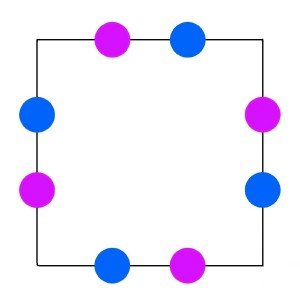 |
Single teacup chain: Start with a normal square set
- men shown blue, girls pink. Head couples are at top and bottom of the diagram.
The men are usually the 'static' dancers
and stay where they are, their only role is to turn girls who come to them by whichever
arm the girl offers.
Head men send girls into the middle of the
set, side men send them off to the diagonal right.
The basic rule is 'always diagonal right' -
ladies aim for the next man to the diagonal right - but twice they need to do a turn in
the middle of the set before going to him. |
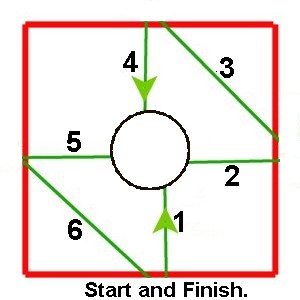 Turns
in the middle of the set are 0.75 for right arms and 1.25 for left arms. It is usual to
the heads to go into the middle of the set first. A typical call is 'Head ladies in for a
teacup chain". |
It can be helpful to visualise
the route taken by an individual 'active' dancer, assumed to be a lady. Here head ladies
move into the centre of the set - but only the track taken by the one at the bottom is
shown. They do a 3/4 right hand turn in the centre. The 'bottom' head lady then moves out
to the right (track 2) to do a left turn on the side. She then cuts across the set (track
3) to do a right hand turn then into the middle again to do a left hand turn 1.25 around
to go out on track 5. She will then cut across the corner of the set again (track 6) to do
a left arm turn with her original partner.
This can all be practised with just two opposite men or ladies leading. In the full dance,
all four men (or ladies) are moving at once. Unlike in a strip the willow square, there
are two right and two left turns on the sides, and one of each type in the middle. The
other two ladies will at the same time be doing something similar but different! (see
diagram below) |
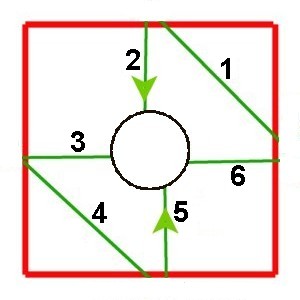
Turns in the middle of the set are 0.75 for
right arms and 1.25 for left arms. |
The other two 'active' lady dancers will
start the teacup chain from side positions by cutting across a corner to a head man.
Thereafter, whilst the moves are similar the first turn in the middle of the set is 1.25
using left hands. Again only one
dancer's tracks are shown. They visit each man in turn (anticlockwise around the set).
From any starting position on the side, the next man they interact with is always the one
to the diagonal right.
It is only pairs of 'active' dancers who do
turns in the middle of the set - not all four together. Viewing the animated sequence
makes this clear.
If the timing is correct, all four 'active'
dancers will be turning the opposite men (on the opposite side of the set to where they
started) at about the same time (and all with right arm turns), and also finishing (with
their partner and left arms turns) at the same time. Turns on either side will not be
synchronised. |
I have my own way of teaching a teacup
chain - and I think it's one of the easiest to remember!
Here goes... :
Start by teaching a strip the willow in a
square set. This is easy (see above within main text) - two opposite women move to the
middle of the square set, do 3/4 a right arm turn and then go to the man who was
originally on their right to do a left arm turn. This whole sequence (a right arm 3/4 turn
in the middle and a left on the side) is defined (by me and for the purposes of teaching a
teacup chain) as MIDDLE. A complete strip the willow dance sequence for (say) the head
women can therefore be taught (and called) as MIDDLE, MIDDLE, MIDDLE, MIDDLE. This
involves eight arm turns. If all four women do it together, they just do a 3/4 right hand
star in the middle instead of a 3/4 right arm turn - again this is easy. The key is
remembering ALWAYS DIAGONAL RIGHT - the man you are aiming for after completing the turn
or star in the middle of the set is always the one who was diagonal right of your last
starting position.
The differences in a teacup chain are that
there are only 6 arm turns to get back home and it can be left or right in the middle or
on the side. HOWEVER - whilst right arms turns in the middle are still always 3/4 the way
around, left arms turns in the middle must be one and a quarter in order to get
you to the correct side of the set. Just remember you always start using a right
arm and each arm is used alternately (right, left, right, left, etc) no matter where you
are at the time. Sometimes however, as an introductory move, all dancers do a left arm
turn with their own partner to begin the sequence.
There is also a new move to define : I call
it CUT. If a dancer is told to CUT this means cut across the corner of the square and do
an arm turn (may be right or left) with the man who is on her right - the same person the
dancer would have gone to when doing a strip the willow dance. The move CUT leaves the
dancer at the same place as at the end of a MIDDLE move - but it has taken less time
because the 3/4 or 1.25 arm turn in the middle of the set has been omitted.
Now explain that one pair of (say) head
women doing a teacup chain will dance MIDDLE CUT MIDDLE CUT whilst at the same time the
other pair of women (the side women) will dance CUT MIDDLE CUT MIDDLE - each will dance 6
arm turns to get home.
Once the moves CUT and MIDDLE are
understood, dancing a teacup chain is as easy as a strip the willow in a square. When
taught differently, it sometimes perplexes even experienced dancers. The real key to it is
to ignore what might be going on elsewhere in the set and focus on visiting every side
position in the correct (anticlockwise) order whilst saying to yourself (for example)
'middle/cut,middle/cut'. Also, girls should remember the golden rule - "always
diagonal right". Men doing the mirror image move (beermug chain) should
remember "always diagonal left" - they visit each woman in turn
in a clockwise direction round the set.
A teacup chain is synchronised only at the start, half way through and at the end of
the sequence. At the start, everyone is with their partner. Half way through every active
dancer is doing a right arm turn with the person of the opposite gender who was OPPOSITE to them when they started. The dance is 'in
phase' at this point because each set of dancers have travelled the same distance - one
pair having danced CUT MIDDLE the other pair MIDDLE CUT. Yet even this is only approximate
because half way through one set of dancers will have done a right hand star and the other
a left hand star - which takes longer. Teacup chains are well known for 'not fitting the
music' and this is one reason why - some dancers finish moves whilst others are half way
through theirs, a situation made worse in alternating teacup chains.......
At the end of the whole sequence each
dancer will be doing a final left arm turn with their original partner, and (ideally) at
the same time!
Unlike in a strip the willow dance, the
four people who are standing still waiting for dancers to come towards them need to keep
awake - they will be required to give a left or a right arm. In Sue Rosen's method of
teaching the dance, everything depends on these 'static' dancers knowing where to send
each 'active' dancer. This becomes crucial in a double teacup or a double beermug chain if
the active dancers get lost - but such a situation is usually irrecoverable because in
these large sets there can be so much distance between the person who has gone wrong and
the person who is most able to help them - the one towards whom they should have been
going.
More complicated versions of a teacup chain
are the alternating teacup
chain and the double teacup chain - both of which were taught at Chippenham Festival
2012 by Colin Hume.
The starting sequence for an alternating teacup chain is
the same as for a simple teacup chain - and the formation is again a simple square set.
The essence of the dance is that each time an 'active' dancer does an arm turn with a
'stationary' dancer (one waiting at the side or head position) the turn is rotated further
so that after each turn on the sides, each active dancer and stationary dancer swap
roles. This has the effect of making pairs of men and women alternately 'active' doing
arm turns in the centre of the set. It is helpful to appreciate that the only people you
work with (have contact with) are your opposite person of the same gender and the two
people next to you - both of whom will be of the opposite gender. Arm turns in the centre
will always be with the same person of the same gender. In practice it is more difficult than a double teacup chain.
The double teacup chain requires 16 people in a set and might be thought of as more challenging
than an alternating teacup chain - but is simpler to dance once
the pattern is understood. The Gittisham Display Dance uses
both double teacup and double beermug moves.
There are many other moves, including a
whole group called Kentucky
Running Set or just Running Set. Irish set and ceili dance is different again, and
with different terms sometimes being used to denote similar or identical moves.
Grand Square - and the related moves grand rectangle, grand
sweep and grand triangle are explained here on a
supplementary page.
Dance Figures
Becket formation A longways set, but instead of partners standing
opposite each other they stand side by side with the lady on her partners right facing
across the set to another couple. The progression is up one side of the set, across the
end, and back down the other side. In some of these dances a couple who have reached the
top or bottom of the set have to 'wait out' for a while before they come back in, in other
dances, there is very little waiting time - so keep awake!
Circle A ring of couples facing inwards, each lady on her
man's right, as usual. It can be a small circle of two or three couples or a large circle
of 50 or more couples round the outside of a large dance hall.
Longways Set A line of dancers, with partners facing across the
set taking hands four from the top forming rings of four, first couples
are No.1 and second couples No.2 (1's moving down the set (away from the music) and 2's
up, until you reach the end and have nobody to dance with (you are then a neutral couple), though in some dances they have to be awake to join in some bits even
though they are neutral. Wait out one turn of the dance and come back in, if you are at
the bottom you come back in as 2's and at the top as 1's. Some dances have the first
couples swap sides, this is known as an
improper set (in American dancing a contra formation), remembering to swap sides again when you get to the end and
change numbers.
Longways Sets A certain number of couples in a Longways set, i.e.
3 couples or up to 8 couples in one set.
Sicilian Circle Couple facing couple around the room in a large
circular formation. Remember which way you are facing around the large circle - you will
usually move only in that direction to progress to subsequent couples coming the other
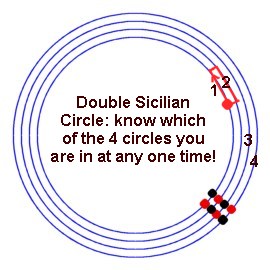
way. There is also a Double Sicilian Circle - this has two couples in each line (4 people
facing four people). If these dances go on for long enough each couple will dance with
every other couple who start facing in the opposite direction. In Double Sicilian Circle
dances, it is common for couples to change tracks after each turn of the dance. For
example, the couple facing anticlockwise and starting on tracks 1 and 2 (man on 1, woman
on 2) may find themselves on tracks 3 and 4 - and again facing anticlockwise to start the
next turn of the dance. They will then swap back again for the third turn of the dance. It
can be important to remember which track you are on and to keep the dance set neat and
correctly positioned on the dance floor. DURING each turn of the dance, any dancer may be
facing either anticlockwise or clockwise - it is only at the start of each turn of the
dance that each couple will be facing in their original direction.
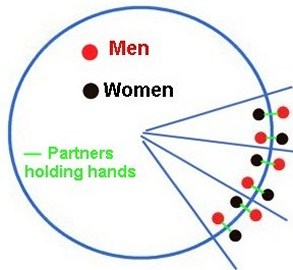 |
 |
 |
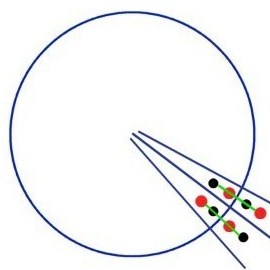
| Sicilian Circle - couple
facing couple all round the large blue circle around the dance hall. Partners usually hold
inside hands to start - women to the man's right as usual. |
A Double Sicilian Circle- two
couples side by side, facing another two couples. The pattern is repeated all round the
blue circle. |
It is important to know which
of the four blue circles you are in at any time! A man may move (as shown) along track 1,
go across to track 2, and then return home. |
Square Set Usually four couples in a square formation, each
couple forming one side of the square. In English folk dance the couples are numbered
anticlockwise, number one nearest the music, in Scottish clockwise (so I am told...).
Couples facing up and down the room are head
couples those facing across the room
are side couples. In some dances
there can be two side couples on each side, but only one head couple at either end (total
six couples). It is still then called a square set despite being rectangular......In Irish
dance the head couples are called top couples (and the sides are still sides). First sides
can be on the right or left (of the first head couple) - it depends on the dance.
If a dance 'falls apart' then reform the set and wait for an appropriate time to
restart, never drop out and sit down! The most common reason for sets to 'fall apart' is
not that the dancers don't know the moves, they fail to get into a correct position on the
floor after each move and so are unable to see quickly where (and with whom) to start the
next move. Correct completion of each move - getting to the correct position on the floor
and facing in the correct direction is of paramount importance for fast and/or complicated
dances.
What type of clothes are most suitable for folk dancing? - click here for my opinions.
SeeRed Local Folk Dance section
Sidmouth Folk Festival section
 |
29 December 2009 - a early endorsement of this webpage
from Google
On 9 May 2016 the page was again top out of 3,110,000 results.
More recently, videos have exploded onto YouTube - it is no longer the age
of static websites. In 2023 there were 26,400,000 Google
results, but this page was still in the top twenty! |