Exeter Ceilidhs at Kenn Centre near Exeter - a 5 year review - 2021 to 2026.
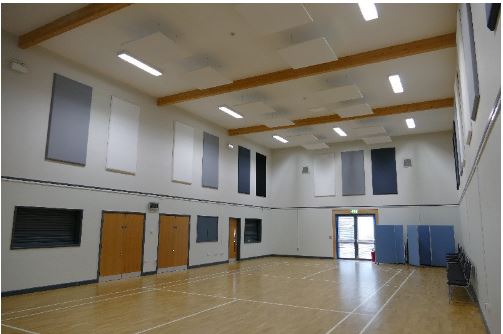
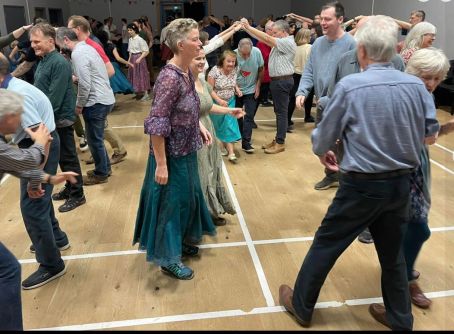
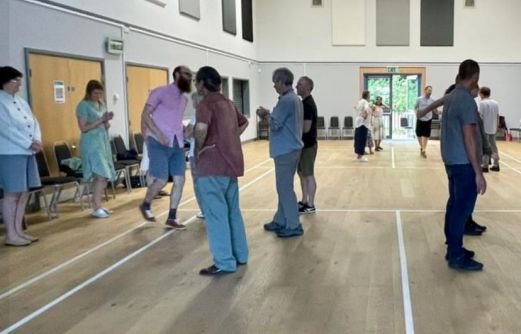
Exeter ceilidhs, organised by Jeremy Child, recently celebrated its 5 year anniversary, and with only the Covid pandemic as an interruption. They are held at the spacious Kenn Centre which can accommodate 80+ high energy dancers. Up to 100 would be possible. Sometimes the hall is packed, on other occasions, especially if some people leave early, there is almost too much space. Ventilation is excellent - via fire doors at either end of the hall, or powerful inlet and exhaust fans can be used. The heating system is under floor and cannot be manually controlled - but temperature is never a problem. Parking is good.
|
|
|
|
Generally the ceilidhs have been held September to June, once per month, with a few additional evenings for contra dance and, in some years, for an extra event between Christmas and New Year. Summaries of all the events held during 2025 are here. The early history and ethos of the series is given here.
During this five year period, these were the only regular folk ceilidhs local to Exeter. The only other large and well attended folk dance venue is at Willand - where the dances are generally more sedate and geared to more experienced and older people (younger people always welcome!). There are still weekly small folk dances at Sidford and Gittisham, and at a few other venues in Devon, but many other small clubs - including the one in Exeter itself - closed down some years ago.
The overall popularity of folk dance nowadays (2026) can be gauged from the fact that Exeter has an adult population of around 100,000 (with a median age less than 40) - and yet the 'in-town' folk dance club did not survive. The ceilidhs at the Kenn Centre have survived because they drew dancers of all ages from a much wider area - as far as North Devon, Sidmouth, and Totnes. Travel distances were as high as 60 miles each way, but at least there was good car parking and a good dance floor once you arrived. Small folk dance clubs can survive with 15 to 25 attendees (Sidford and Gittisham are now in this category, whereas they used to attract 75 and 35 respectively, and they both cater primarily for older people). The catchment area for Exeter Ceilidhs contains at least 250,000 potentially fit and active adults. If 100 ever attended, that would be 0.04%, which gives some indication of the popularity of folk dance in the UK. Even in mainland Europe, I doubt the figure is more than 0.1%, or 1 in every 1000 adults. Far more people use on-line dating sites, yet dance could arguably be more effective: at a large event, you could meet dozens of real people in an evening. On-line dating remains a huge, lucrative and varied business.
During the period 2021 to 2026, Exeter Ceilidhs attracted between 35 and 85 dancers, whereas Willand generally attracted 20 to 45 - down from the peak of 120+ that was achieved over 25 years ago. Therefore, in terms of attendance, Exeter ceilidhs has done very well, especially as only a few seasoned Willand dancers now attend. Reasons include that a few younger dancers are too rough, the music is sometimes too loud, and the dances are too simple. A principal reason for some experienced dancers however, has been that far too much time is spent explaining the simplest moves - month after month.
Exeter Ceilidhs has been the prime (maybe the only) Devon venue regularly to attract young newcomers to folk dance. Some events at Kenn have been fantastic - well up to the standard of the best at folk dance festivals of past years. Others have been problematic, especially in recent years when the advent of 'gender neutral' calling made dances less enjoyable for the majority of people, and also added to confusion amongst newcomers.
The 'gender neutral' issues are discussed elsewhere - and especially here. During 2025 several callers at Exeter Ceilidhs tried to be 'politically correct' but following criticism on this website and elsewhere (including from attendees), normality is making a welcome comeback. Men and woman are now addressed as such, and dancers know more readily where they should be, and what they need to do.
The event on 28 February 2026 with Flash Company (a local band) and Pete Langley as the caller was however one of the less successful events. The reasons are given below, together with a summary of what has been achieved in 5 years - and critically, how much else might have been (and still could be) achieved.
What went wrong on 28 February 2026 - and how could it have been better?
This was a ceilidh that that I almost didn't attend because the band are known to be rather loud, and the caller does not generally do particularly interesting dances.
What went right during the evening.
Overall, it was well worth attending, if only because it provided some excellent examples of why gender-neutral calling is not to be recommended for newcomers, or indeed for any dancers. In the absence of a couple of my regular dance partners, there were a number of newcomers who were willing to learn. It was also quite well attended overall - and not too many people left before the end. The music was generally very danceable. Some of the dances were more adventurous than those relied upon by other callers.
What went wrong during the evening - and how might it have been prevented?
The evening started late, simply because there were few people in the hall. I tried to do the introductory polka with Sylvia, Jeremy Child's wife, but I had to stop because of a stiff knee. But (see below) I made up for it at the end of the evening.
The first dance was a circle - often a good choice because people can move on (change partners) and meet many of the other dancers. But the caller said he would be denoting people as odd and even (instead of men and women). This proved to be a particularly silly example of gender neutral calling - and it soon had some people confused. The odd people were said to be on the left - thus for couples who had already arranged themselves in the usual format, men were denoted as odd. I objected to being called odd. Quite a few newcomers forgot whether they were odd or even and which way they should be moving, During one square dance, even Pete Langley became confused - so he reverted to men and women!
Later in the evening we did another simple circle dance - the circle waltz. I must have danced this 50 times although I have only called it once. It is a straightforward, very simple dance, and it works well when traditional calling is employed. In this case, we had odds and evens and also for some inexplicable reason, Pete Langley tried to make us turn to the left to face our new partner and then to do the chasse move. That took us out of the set rather than into it. Also, we were in the wrong orientation to do the final 4 bars of waltz. Despite other people telling him he had got it the wrong, Pete Langley persisted in this difficult way of doing a standard dance. Once again, this was to the disadvantage of the newcomers. Experienced dancers simply became exasperated.
Newcomers to folk dance are very valuable. Therefore every effort should be made make the evening pleasurable for them and to encourage them to come back.
Because the circle waltz is a progressive dance (even when done incorrectly), I was afforded many opportunities to tell people (mostly women). that it was not their fault that so much was going wrong.
Later in the evening we did the Bucksaw Reel (or something very similar) . I may have danced the Bucksaw Reel 50 times, usually on autopilot, although I have never called it, It's not the Buckshaw Reel either!
Here is the history of the Bucksaw Reel dance.
The dance was explained, and we had to walk it several times before people got some appreciation of what they were supposed to do. I had a complete newcomer as a partner - I previously had to teach her a right and left through. The music by this time had become far too loud and when we got to the bottom of the hall, it was impossible to hear the calling. The set disintegrated into a melee. I told my partner several times that it was not her fault that she was going wrong, and that, in the circumstances, she was doing very well. She did say on a couple of occasions, rather despondently, that she hadn't the faintest idea what she was doing. Neither did other members of the set, some of whom were experienced dancers and, like me, were trying to correct mistakes made by other people.
I am not convinced that the dance was, in fact, the Bucksaw Reel. It may have been something similar.
I danced a few sets with a very tall girl who had some small experience of ceilidh dancing, but she didn't know how to do a reel. We did the Cornish Six Hand reel, which was called correctly. I taught her how to reel, She did the whole dance very well, and I told her afterwards (by way of encouragement) that if she could cope with me as a partner (using extra turns and fast swinging), she could probably cope with any man.
We did another couple of dances together, and she was either rather tired at the end or (maybe) fed up of me bossing her about (but gently!)
Much of the music was very danceable. It was simply too loud. The band did launch on one occasion into a rendering The Sloe, one of my favourite polka tunes. But I can't say that it was played to perfection.
At the end of the evening the band played a series of polka tunes. I was lucky enough to dance with Jeremy Child's wife, Sylvia. She's an incredible dancer. She even managed to compensate for my imperfections with a slightly stiff knee. We danced round the hall many times. We ended up, as I often try to do, as the last couple dancing. From then on, I think the band were trying to kill me by continuing to play. At the end, eventually, I'm not sure how much longer either of us could have continued, This is how dance evenings should end.
One of my American square dance partners who is an intelligent and competent dancer (and a woman of firm opinions), was so disillusioned with Pete Langley's calling, and especially it's dispiriting effect on one of her friends (who is not an expert dancer) that towards the end of the evening, she said to me, "Oh f*** it. I'm sorry, Steve, but we're going. I can't stand any more of this. He's hopeless."
Lessons to be learned?
Use traditional man and woman calling - it works, and people understand it. Most people prefer it too.
The music should assist the dance - not overwhelm it, and especially not to the extent that the caller cannot be heard.
After five years of Exeter Ceilidhs, the standard of dance has not improved. Many events have complete newcomers (and many of them never come more than once). So at every event, dances have to be simple and with basic moves explained. Some callers (Chris Jewell for example) do try to push the boundaries of what is possible with newcomers - and often it works.
It might have been better to encourage all newcomers over the years to attend teaching classes (as used to be held by folk dance clubs) so that they might be encouraged to become more competent, and attend again. Many younger people have attended once or twice - never to be seen again. If a sizeable number had been retained as dancers over the years, then a new dance club composed primarily of younger people could have been formed - and might now be thriving, much as (25 years ago) there was a sizeable folk dance group at Exeter University. In those days there were sufficient students (and past students) to fill a coach to attend IVFDF. Nowadays a small taxi might suffice. I have tried over the years to offer dance lessons - but whilst one or two people are sometimes interested, I have never been able to obtain a group of eight. And certainly not eight who were all free at the same times and dates! Other folk dancers and callers who have tried to entice newcomers via leafleting, advertisements, and letters in newspapers have fared no better.
There were a few lessons also from the following event held on 28 March with band Phoenix and caller Mary Howells.
First, the music was too loud throughout the evening. Mary only did very simple dances, the evening started late and ended early, losing about 30 minutes in total. One dance, Boston Tea Party, was called unusually, and while I and other experienced dancers simply ignored her instructions, some newcomers found the dance awkward. On the plus side, there were a number of keen younger dancers several of whom promised me that they would come again. But I have heard that so many times before!
What would make a perfect ceilidh and/or folk dance evening?
1. A one hour introductory session maybe with recorded music, and to include some dance teaching, in preparation for the main event. All inexperienced dancers to attend.
2. A full 3 or 4 hours of dance with an enthusiastic band and caller, and with at least 60 to 80 fit dancers. 60%+ women would be good too, to provide for a selection of partners. Aim for at least 20 to 25 dances.
3. A wind-down session for the keen dancers, again maybe with recorded music and comprising waltzes, polkas, schottisches and other couple dances, where no calling would be required.
4. The whole event to last 6 hours and with minimum breaks - maybe coffee and biscuits for 20 minutes.
5. Penalties for anyone who didn't dance every dance, or who left early.
6. Repeat monthly.
Review of some of the 2025 dances that I attended.